
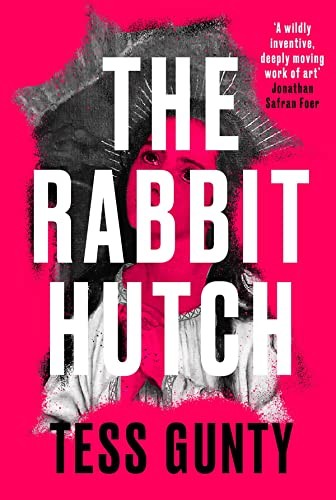
The Rabbit Hutch
Tess Gunty · b. 1992 · United States
Why it matters
A former foster teenager obsessed with medieval mystics and the tenants of one shabby Rust Belt apartment building collide toward a single strange night of violence. Gunty's National Book Award-winning debut renders American decline with visionary intensity.
At a glance
A large ensemble cast and shifting formal registers ask readers to track multiple threads at once.
Deep dive
In a dying Indiana factory town, an eighteen-year-old who reads about mystics escaping their own bodies gets a violent, unwanted lesson in exactly what leaving a body actually costs, in Tess Gunty's telling of one overheated week at an apartment complex called La Lapiniere.
Written for readers who have finished the book. No plot recap, and nothing here is safe to read first.
Themes & symbolism
Blandine Watkins, aged out of foster care and sharing a subsidized apartment with three teenage boys who share her history, spends her days absorbed in the writings of medieval mystics like Hildegard of Bingen, women who described their own visions as a kind of bodily escape, transcendence achieved by starving or otherwise punishing the flesh. Gunty sets that historical material against Vacca Vale, Indiana, a Rust Belt town gutted by an auto plant's closure and now targeted by a development scheme that treats its remaining residents as an obstacle to redevelop around, and lets Blandine's fixation on mystical self-erasure read as the logical extreme of a place that has already, in every practical sense, stopped valuing the people living in it.
The novel widens outward from La Lapiniere, the crumbling apartment complex that gives the book its title, through a rotating cast of neighbors, a new mother struggling with dissociation, an actor haunted by a role, and Joan, a moderator scrubbing violent content and grief-stricken comments from a memorial website, whose stories keep circling the same argument: that ordinary American precarity, foreclosed jobs, absent parents, algorithmic surveillance, produces its own species of disembodiment long before anyone reaches for Hildegard's visions to explain it.
La Lapiniere as a Character
Gunty gives the apartment building its own interstitial narration, gossiping about its tenants in a collective, almost choral voice that treats the structure itself as a kind of witness. The device keeps the novel from settling into any single character's tragedy; the building has seen this pattern of neglect and disappointment before, and will see it again after the events of this particular week are over.
Vacca Vale's Development Plot as Ecological Horror
Running underneath the personal plots is a municipal subplot, a proposed redevelopment that would demolish the town's remaining wetland habitat for a park nobody who lives there actually asked for, and Gunty treats that civic indifference as continuous with everything happening to Blandine: a system willing to bulldoze a marsh for a photo opportunity is the same system that lets a barely supervised teenager fall through every safety net designed, on paper, to catch her.
The last seal: what actually happens, and why it lands the way it does.
The ending, explained
The violence the novel has been building toward arrives sideways rather than head on: Blandine's roommates, spooked and drunk, turn on a goat she has been secretly sheltering in the courtyard, and when she throws herself between the animal and Todd, he stabs her. At almost the same moment, Moses Blitz, a grieving, unstable young man who has crossed the country to confront Joan over a deleted comment on his dead mother's memorial page, breaks into the wrong apartment entirely, naked and smeared in glowstick paint, and finds Blandine bleeding on the floor instead. Gunty refuses either collision the clean causality a news report would impose on it: the harm circling La Lapiniere all week was never really about any one grievance, it was already loose in the building, waiting for wherever it would land.
Where to go next
 Jonathan Franzen · 2001The CorrectionsLvl 6Medium pace
 Jason Mott · 2021Hell of a BookLvl 5Medium pace
 A. M. Homes · 2012May We Be ForgivenLvl 5Fast paced
 Ruth Ozeki · 2021The Book of Form and EmptinessLvl 5Medium pace
 Alice McDermott · 1998Charming BillyLvl 5Slow burn
 Tayari Jones · 2018An American MarriageLvl 3Fast paced