
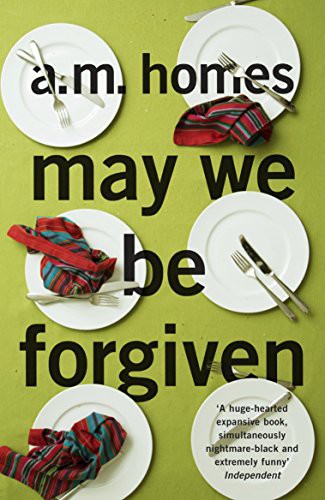
May We Be Forgiven
A. M. Homes · b. 1961 · United States
Why it matters
A mild academic's affair with his brother's wife detonates into a cascade of accidents, violence, and institutionalization, leaving him improvising a chaotic new family out of his brother's children. A sprawling, transgressive black comedy about the wreckage of contemporary American domestic life.
At a glance
A large cast and escalating incident keep the plot busy, though the prose itself stays accessible.
Deep dive
What happens to a mild, unremarkable Nixon scholar named Harold Silver when his volatile brother's single afternoon of violence hands him, without warning, an entire ready-made family to raise.
Written for readers who have finished the book. No plot recap, and nothing here is safe to read first.
Themes & symbolism
Harold "Harry" Silver narrates from deep inside two overlapping catastrophes: an affair he has already started with his brother George's wife, Jane, and the chaos George detonates around it, a car crash that leaves two strangers dead and George briefly institutionalized, then a single unmonitored afternoon in which George, finding Harry and Jane together, beats Jane to death with a lamp. Homes delivers all of this in the book's first fifty pages, in flat, almost administrative prose, then spends the next five hundred on the unglamorous labor that follows: school runs, custody hearings, a bar mitzvah, the daily maintenance of raising George and Jane's children, Nate and Ashley, that nothing in the opening chapters prepares a reader to expect as the novel's actual subject.
Harry has spent decades annotating Richard Nixon, a president remembered by history for one act that swallowed an entire career, and Homes lets that project sit as an oblique mirror for Harry's own situation: a man hoping that a longer record might eventually complicate a single defining transgression, his own affair chief among them. The novel's title borrows the language of collective confession from the Yom Kippur liturgy, in which a congregation recites sins in unison regardless of which member actually committed them, and Homes applies that logic literally: forgiveness here is never granted in one scene by one wronged party, it accumulates, unevenly and incompletely, out of everyone in the book absorbing a portion of guilt that isn't strictly theirs.
A Suburb That Absorbs Its Own Wreckage
Homes surrounds the central tragedy with a string of increasingly absurd subplots, a webcam sex scandal at a retirement community, an improvised trip to South Africa, a wandering journey to Cuba, that read as comic excess until it becomes clear they're doing the same work as the main plot: American plenty swallowing chaos whole and calling the result normal life. The suburb itself never has to reckon with what happened in it; it just keeps running errands.
Care Work as the Novel's Real Plot
Once Harry moves into George's house, Homes tracks the mechanics of parenting in a level of domestic detail rare in literary fiction about male protagonists, cereal brands, permission slips, a child's grief expressed through video games rather than words. The novel's argument is structural as much as thematic: redemption doesn't arrive as insight, it arrives as thousands of small, repeated, non-dramatic acts of showing up.
The last seal: what actually happens, and why it lands the way it does.
The ending, explained
George, stabilized enough to leave the psychiatric facility, returns to a household that has entirely rebuilt itself without him: Harry effectively remarried into fatherhood, Nate and Ashley settled into routines George never established, a foster child from South Africa and Jane's aging parents folded into the family's improvised shape. Homes refuses either full reconciliation or clean rupture, George is welcomed back tentatively, still monitored, still capable of doing damage, while the new household keeps functioning around him rather than waiting for him to complete it. The book ends on an ordinary family dinner, an image whose entire argument is that recovering from this much harm looks like nothing more dramatic than everyone showing up and passing the plates.
Where to go next
 John Irving · 1978The World According to GarpLvl 4Fast paced
 Tess Gunty · 2022The Rabbit HutchLvl 5Medium pace
 Jonathan Franzen · 2001The CorrectionsLvl 6Medium pace
 John Kennedy Toole · 1980A Confederacy of DuncesLvl 4Fast paced
 John Cheever · 1978The Stories of John CheeverLvl 4Medium pace
 DBC Pierre · 2003Vernon God LittleLvl 5Fast paced