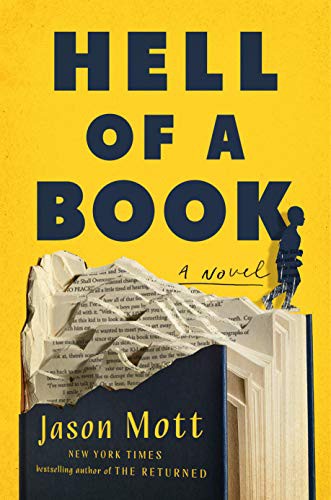
Hell of a Book
Jason Mott · b. 1978 · United States
Why it matters
An unnamed Black novelist's reality-blurring book tour is repeatedly interrupted by news of Black men and boys killed by police violence, comedy curdling into grief without warning. Mott's genre-blurring National Book Award winner refuses to separate the surreal from the real.
At a glance
Reality-blurring, digressive narration shifts registers abruptly between comedy and grief.
Deep dive
An unnamed Black author on a chaotic cross-country book tour keeps running into a boy only he can see, and Mott braids that haunting together with the story of a Black child in another town about to learn exactly what color he is in the eyes of a frightened police officer.
Written for readers who have finished the book. No plot recap, and nothing here is safe to read first.
Themes & symbolism
Mott's narrator, an unnamed Black novelist promoting a bestseller while barely holding himself together, keeps encountering a small boy nobody else can see or acknowledge, an apparition he calls Soot for how shock and fear seem to have blackened him. Mott interleaves the narrator's increasingly unreliable, often darkly funny tour chapters with a separate, plainly told story of another boy, unnamed for most of the book, growing up being taught by his father exactly how to survive encounters with police, a lesson delivered with the weary specificity of a survival manual rather than an abstraction.
The novel's structural gamble is trusting the reader to hold the narrator's manic, digressive unreliability, he isn't sure, often, what's actually happening around him, whether reporters are real, whether the tour is going the way he thinks it is, against the other boy's story, told with total narrative clarity, and to feel the growing pressure between those two registers as the book's actual argument: that trauma this specific to being Black in America can produce both kinds of narration, the fractured, defensive one and the flatly, unbearably clear one, sometimes in the same family, sometimes in the same person.
Soot as Diagnosis and as Character
Mott keeps Soot's ontological status genuinely unresolved throughout, ghost, hallucination, memory, or some combination the narrator himself can't settle on, and uses that ambiguity to argue that grief over anti-Black violence doesn't need a single confirmed origin to be real and structuring: Soot functions in the narrator's life exactly like trauma functions, a presence whose reality is beside the point next to the damage it's already done.
A Comic Novel That Refuses to Stay Comic
Much of the narrator's tour material plays as genuine satire, publishing-industry absurdity, a media landscape obsessed with turning Black pain into content, a hotel-room farce or two, and Mott lets that humor run for long stretches specifically so its collapse, whenever the other boy's story intrudes, lands harder. The novel's tonal whiplash isn't a flaw in craft, it's Mott replicating, formally, what he's arguing is true of Black life in America: comedy and catastrophe sharing the same room, sometimes the same sentence, with no reliable warning before one turns into the other.
The last seal: what actually happens, and why it lands the way it does.
The ending, explained
The two narratives converge when the narrator finally recognizes what the novel has been building toward: the other boy's story is his own childhood, and the police shooting his father spent the whole book training him to survive did in fact happen, a loss the narrator's mind split off into a haunting rather than a memory because carrying it directly was unbearable. Soot, it turns out, has been the narrator's own younger self all along, not a separate ghost but the boy he was before the trauma reorganized his identity into someone who could keep functioning, touring, joking, publishing. Mott ends without offering the narrator a clean recovery, the book tour continues, the media circus continues, but the narrator's recognition of what Soot actually is gives the novel's chaos a center it didn't have before, an act of the narrator finally being willing to know his own story rather than narrate around it.