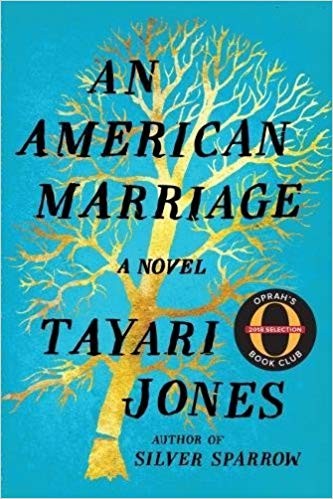
An American Marriage
Tayari Jones · b. 1970 · United States
Why it matters
Newlyweds Roy and Celestial's marriage is upended when Roy is wrongly convicted and imprisoned, their bond tested by years of letters and Celestial's growing closeness to a childhood friend. An Obama-endorsed, Oprah-selected novel that asks what home and fidelity still mean after wrongful rupture.
At a glance
Clear, direct prose and alternating narrators make for an accessible, emotionally driven read.
Deep dive
Roy and Celestial are less than two years into their life together when a wrongful conviction sends him to prison for a crime that happened somewhere he wasn't, and Jones spends the years that follow measuring what two people, changed at wildly different speeds by the same injustice, still owe each other.
Written for readers who have finished the book. No plot recap, and nothing here is safe to read first.
Themes & symbolism
Jones splits the novel's early sections into alternating letters between Roy and Celestial, a formal choice that puts the reader inside the specific, corrosive experience of a couple trying to sustain intimacy through a wall neither of them chose: Roy in prison for a rape he didn't commit, misidentified by a traumatized victim in a case where race did as much work as evidence, and Celestial outside, expected by everyone including Roy to simply wait. The letters track how unevenly time actually passes for the two of them. Roy's world narrows to the sentence itself, while Celestial's, however constrained by grief and obligation, keeps moving, her handbag design business taking off, her old friend Andre growing steadily closer.
Jones is explicit that this isn't a novel about whether the justice system failed Roy, that's established fact from the opening pages, it's a novel about what a marriage is actually made of once one half of it becomes a legal abstraction, a wrongfully convicted man rather than a specific person with specific weekly demands on his wife's attention. Andre, Celestial's childhood best friend and Roy's own groomsman, isn't written as a home-wrecker so much as evidence of how much ordinary, present life a five-year sentence steals from a marriage that never had the chance to fail on its own terms.
Letters as the Only Marriage Roy Has Left
For roughly the novel's first third, the entire relationship exists only as correspondence, a form Jones uses to strip away every non-verbal register a marriage usually runs on, touch, shared meals, the ability to read a spouse's face, leaving Roy and Celestial only the words they choose to commit to paper. The gap between what each letter says and what each of them is actually feeling widens steadily, and Jones renders that gap as the novel's real subject: two people getting less and less accurate information about each other precisely when they need more.
Roy's Two Fathers
Roy's biological father, Big Roy, and his mother's second husband raised him with two different models of Black manhood and endurance, and prison forces Roy to draw on both, Big Roy's hard-won stability and his stepfather's quieter example of loving a family he didn't create out of pure choice rather than biology. Jones uses that inheritance to complicate the novel's ending, since Roy's release forces him to ask which kind of father, and which kind of husband, he's actually capable of being now.
The last seal: what actually happens, and why it lands the way it does.
The ending, explained
Roy's conviction is overturned after five years when new evidence clears him, and he comes home to find Celestial has, in the meantime, built a life and a relationship with Andre that she's not willing to simply set aside because Roy's innocence has finally been legally confirmed. Jones refuses the reunion the setup seems to promise: Roy's homecoming doesn't restore the marriage, it exposes how completely the years apart have made Roy and Celestial into people the other one no longer entirely recognizes. The novel ends with Roy accepting, slowly and without a clean resolution, that Celestial has chosen to stay with Andre, and with Roy's own hard-won clarity that surviving the system that wronged him doesn't obligate anyone, including his wife, to hand him back the exact life it took. Jones's last pages give Roy something quieter than reconciliation, the beginning of a life built on his own terms rather than on the marriage's original blueprint.