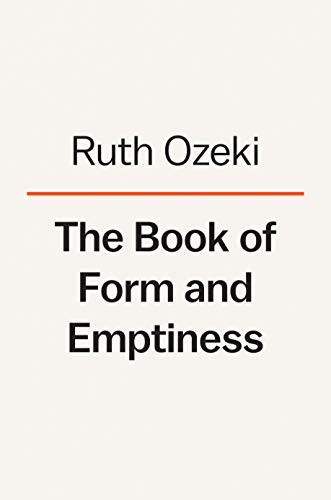
The Book of Form and Emptiness
Ruth Ozeki · b. 1956 · United States / Canada
Why it matters
After his father's death, fourteen-year-old Benny starts hearing voices from ordinary objects as his mother spirals into hoarding; a mysterious talking Book narrates his retreat into the public library. A long, gentle novel that folds Buddhist attention into very contemporary grief.
At a glance
Substantial length and a metafictional narrating device ask for patience, though the prose stays accessible.
Deep dive
Why a grieving teenager who can hear his dead father's old clarinet, his own sneakers, and a pair of nail scissors talking is, in Ruth Ozeki's telling, the character in the household actually managing his loss best.
Written for readers who have finished the book. No plot recap, and nothing here is safe to read first.
Themes & symbolism
Benny Oh starts hearing the objects around him speak in the months after his father Kenji, a jazz musician, dies in a freak accident, a wilted head of lettuce complaining, his sneakers negotiating with each other, a growing chorus that eventually drives him out of the house and into the local public library, the one place he finds where things, mostly, know to keep their voices down. Ozeki treats the voices less as a diagnosis to be cured than as an inheritance: Benny's father heard music in ordinary objects too, and the novel keeps the line between grief-triggered hallucination and a genuinely animist way of experiencing the world deliberately unresolved.
Ozeki gives the book itself, Benny's own book, a narrating voice, addressing him directly, arguing with him about how his story should be told, occasionally losing patience with him. It's a Zen-inflected joke made structural: the novel about a boy who can't stop objects from speaking to him is itself an object that won't stop speaking to its subject, and the running argument between Benny and his Book about authorship becomes the novel's real question, who gets to decide what a life means while it's still being lived.
Annabelle's Hoarding as a Parallel Grief
While Benny's grief externalizes as literal voices, his mother Annabelle's takes the opposite, more familiar shape: she buries her loss under accumulating clutter, clipping articles, saving mail, filling the house until its floor plan becomes an obstacle course. Ozeki refuses to rank the two responses, Benny's hallucinations are treated by doctors as the more urgent problem, but the novel is careful to show Annabelle's hoarding doing the identical psychological work, holding onto physical matter because the person who mattered most is gone.
The Library as an Alternative Institution
Ozeki sets the public library up against every other institution the novel puts Benny through, the psychiatric ward, the school counselor's office, as the one place built specifically to hold difference without pathologizing it: a homeless philosopher, an artist performing between the stacks, a fourteen-year-old hearing voices, all treated as patrons rather than problems. That contrast does real argumentative work, suggesting that what heals Benny isn't diagnosis but a room willing to let him be strange in public for as long as he needs to be.
The last seal: what actually happens, and why it lands the way it does.
The ending, explained
Benny, hospitalized after his condition worsens, eventually reclaims some authority over his own story from the Book that has been narrating around him, insisting on being heard on his own terms rather than diagnosed into silence. With help from the friends he's found at the library, a street artist and a homeless philosopher who each hear the world differently themselves, and with Annabelle finally beginning to clear the house rather than bury herself further in it, Benny and his mother arrive at something short of a cure but real: both of them learning to live alongside voices, literal and otherwise, instead of being either ruled by them or forced to silence them completely. Ozeki ends the novel with the Book handing narration fully back to Benny, a small formal gesture that mirrors the larger one, a boy finally trusted to tell his own story.