
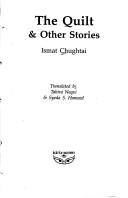
The Quilt and Other Stories
Ismat Chughtai · 1911–1991 · India
Originally The Quilt and Other Stories (Urdu) · translated by M. Asaduddin
Why it matters
The title story's glancing view of a neglected wife's affair with her maid put Chughtai on trial for obscenity. A landmark of women's Urdu writing: female desire and bourgeois hypocrisy skewered with wicked candor.
At a glance
Compressed, allusive short stories where meaning turns on what's implied rather than stated.
Deep dive
The story a Lahore court tried as obscenity in 1944, and what a child narrator's half-understanding of the shadow on the wall was actually built to protect.
Written for readers who have finished the book. No plot recap, and nothing here is safe to read first.
Themes & symbolism
"Lihaaf," the title story translated here as "The Quilt," narrates a young girl's stay with her distant relative Begum Jaan, a wealthy wife neglected by a husband more interested in young men than in her, and the girl's uncomprehending, fascinated account of the strange shapes moving under Begum Jaan's quilt at night, produced by the household maidservant Rabbo's nightly visits, is Chughtai's most famous formal decision: desire between two women rendered entirely through a child's half-understanding, which lets the story imply everything while stating almost nothing directly. That indirection wasn't coy restraint so much as strategy, giving the story just enough deniability to exist inside a literary culture that had no other way to publish it.
Across the wider collection, Chughtai keeps returning to women negotiating desire and survival against domestic and economic constraint, servants, wives, widows managing husbands, households, and each other with a pragmatism closer to comedy than melodrama, since Chughtai's narrators tend to notice the absurdity in their own constrained situations rather than simply suffer them. That wry, unsentimental register, women as sharp-eyed operators within confinement rather than passive victims of it, is what separates Chughtai from many of her Progressive Writers' Movement contemporaries even when she's covering similarly grim material.
The Obscenity Trial in Lahore
"Lihaaf" was tried for obscenity at the Lahore High Court in 1944, alongside a separate charge against Saadat Hasan Manto for a story of his own that year, and Chughtai, summoned from Bombay, refused to apologize or have the story withdrawn, eventually winning acquittal after the prosecution failed to identify a single explicitly obscene word in the text itself, since the story's entire method is implication rather than statement. The trial made Chughtai's name as much as the story did, and she wrote about the ordeal afterward with the same dry irreverence that runs through her fiction.
A Child Narrator Who Knows Less Than the Reader
The unnamed girl telling "Lihaaf" reports what she sees without the vocabulary to interpret it, curious shapes under a quilt, Begum Jaan's private laughter, and Chughtai builds the story's tension entirely out of the gap between the girl's innocent description and the adult reader's growing certainty about what's actually being described, a technique that gives the story deniability in court while giving the reader nothing to actually doubt.
Where to go next
 Intizar Husain · 1979BastiLvl 6Slow burn
 Banu Mushtaq · 2025Heart Lamp: Selected StoriesLvl 4Fast paced
 Premchand · 1936GodanLvl 3Medium pace
 Qurratulain Hyder · 1959River of FireLvl 8Slow burn
 R. K. Narayan · 1958The GuideLvl 3Medium pace