
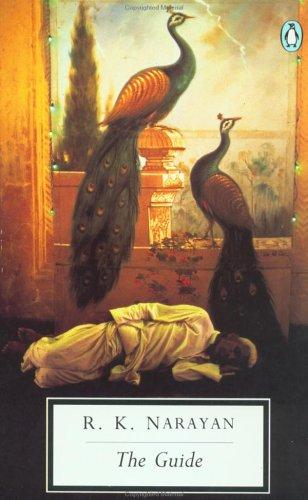
The Guide
R. K. Narayan · 1906–2001 · India
Why it matters
Railway Raju (tour guide, lover, convict) is mistaken for a holy man by villagers who won't let him quit the part. Malgudi's finest hour: comic irony about performance and faith that tightens, page by page, into something more serious than Raju bargained for.
At a glance
Clear, wry prose with a dual timeline that's easy to follow.
Deep dive
A glib railway guide talks his way into a dancer's career and a fortune, loses both, and then, penniless in a strange village, talks his way into being mistaken for a holy man, with consequences he can no longer talk his way out of.
Written for readers who have finished the book. No plot recap, and nothing here is safe to read first.
Themes & symbolism
Raju's whole career, guiding tourists around Malgudi, managing Rosie's transformation into the celebrated dancer Nalini, running the scheme that eventually convicts him of forging her signature, is built on the same skill applied to increasingly serious stakes: telling people a version of themselves and the world that they want badly enough to pay for. Narayan doesn't treat this as simple con artistry. Raju is genuinely good at recognizing what Rosie needs, a manager and audience for a talent her husband Marco has only ever treated as an embarrassing distraction from his archaeology, and genuinely ruins it once his management curdles into possessiveness and then fraud.
The second half strands Raju, fresh out of prison, in a village where an old habit, talking with confident authority to anyone who will listen, gets misread by villagers looking for a holy man as the real thing. Narayan lets the misreading deepen gradually rather than staging a single moment of decision: Raju plays along because refusing feels harder than accepting, then finds himself giving genuine spiritual counsel he half believes, then finds he can no longer step back out of the role that food, shelter, and devotion have built around him.
Rosie's Career as the Real Subject
Rosie's rise from an unhappy, culturally disdained marriage to a celebrated classical dancer performing under the stage name Nalini is, structurally, the novel's actual success story, and Narayan is careful to let her survive Raju's downfall entirely intact: she doesn't need him by the end any more than Marco ever deserved her, and the novel's clearest moral judgment falls not on her ambition but on Raju's inability to be a manager without also becoming an owner.
A Fast Borrowed From Political Theatre
The villagers' demand that Raju fast to end the drought echoes, unmistakably, the political fast as Gandhi had made it a national instrument only a decade or two earlier, and Narayan uses the borrowed form to ask an uncomfortable question about that instrument itself: what happens when a fast's power depends entirely on an audience's faith in the man undertaking it, and that man privately knows he has no special claim to holiness at all.
The last seal: what actually happens, and why it lands the way it does.
The ending, explained
As the drought drags on and the villagers' faith in him hardens into certainty that his fast will bring rain, Raju finds he can no longer explain away the role without destroying the one thing that has finally made him feel necessary rather than merely useful. He commits to the fast in earnest, growing weaker over the famous final pages, and on what seems to be the last morning tells the men supporting him that he can feel rain coming from the direction of the hills. Narayan cuts the novel off at that instant, before confirming whether rain actually falls or whether Raju survives to see it, so that the question the whole second half has been building toward, whether a con man's performance of holiness can become the real thing simply by being believed hard enough, is never answered, only staged one last time.
Where to go next
 R. K. Narayan · 1943Malgudi DaysLvl 2Fast paced
 Mahasweta Devi · 1974Mother of 1084Lvl 5Medium pace
 Banu Mushtaq · 2025Heart Lamp: Selected StoriesLvl 4Fast paced
 Alan Paton · 1948Cry, the Beloved CountryLvl 4Medium pace
 Mulk Raj Anand · 1935UntouchableLvl 3Fast paced
 Ismat Chughtai · 1942The Quilt and Other StoriesLvl 4Fast paced