
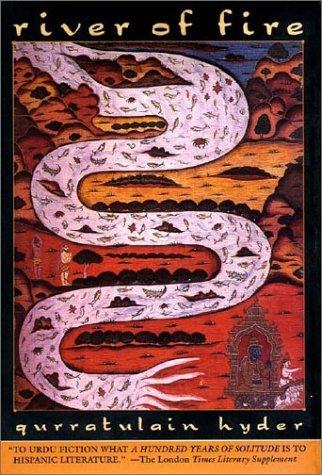
River of Fire
Qurratulain Hyder · 1927–2007 · India / Pakistan
Originally Aag Ka Darya (Urdu) · translated by Qurratulain Hyder
Why it matters
Reincarnated characters recur across 2,500 years of subcontinental history, culminating in Partition's trauma. Urdu fiction's great civilizational novel, and Hyder's own English self-translation of her original text.
At a glance
Sweeping, non-chronological structure spanning millennia with recurring, reincarnated identities.
Deep dive
The same handful of souls keep meeting each other across twenty-five centuries of the subcontinent's history, and what the novel is doing when it finally brings them face to face with a line on a map that didn't used to exist.
Written for readers who have finished the book. No plot recap, and nothing here is safe to read first.
Themes & symbolism
Aag Ka Darya moves across four widely separated eras, ancient India under the Nandas and Mauryas, the Sultanate and Mughal centuries, British colonial Bengal, and the final approach to 1947, and carries the same handful of names through all of them: a scholar recurring as Gautam, a woman recurring as Champa, a wanderer recurring as Kamal, an outsider recurring as an Englishman named Cyril in the colonial section. Hyder isn't writing four historical novels stitched together. She's arguing that the subcontinent's civilization is a single continuous life that political and religious regimes pass through rather than a sequence of separate peoples replacing one another.
Each era restages the same encounters, love that crosses a religious or communal line, friendship that survives a change of ruler, betrayal that has nothing to do with which empire is currently in charge, so that by the time the novel reaches the twentieth century, the reader has already watched Hindu, Buddhist, Muslim, and Christian identities move through the same handful of souls without any of them proving to be the fixed, essential thing later nationalism will insist they are.
The novel's furthest reach backward, into the Mauryan and Sultanate centuries, is what makes its arrival at Partition land as hard as it does: a subcontinent Hyder has spent hundreds of pages showing as endlessly mixed and endlessly recombining is carved in 1947 along a line that treats those same fluid identities as if they had always been separate and opposed.
A Novelist Rewriting Her Own Translation
Hyder wrote Aag Ka Darya in Urdu in 1959 and, decades later, produced the English River of Fire not as a straight translation but as a substantial rewrite, trimming and reshaping the novel for a different readership while keeping its reincarnation structure intact, an unusual act of authorial revision that treats the English version as a second original rather than a copy of the Urdu one.
Reincarnation as Historiography
By giving its recurring souls new names, faiths, and allegiances in each era rather than continuous memory of their past lives, the novel refuses the comforting version of reincarnation where a soul learns and improves across lifetimes: history here doesn't accumulate wisdom, it just keeps handing the same people the same choices under different names, which is Hyder's real case against nationalist history's claim to be something new.
The last seal: what actually happens, and why it lands the way it does.
The ending, explained
In the novel's final movement, the twentieth-century versions of Gautam, Champa, and Kamal are separated by the new India-Pakistan border exactly as their ancient and medieval selves were once separated by war, plague, or a change of dynasty, except that this time the separation is permanent and the paperwork to cross it doesn't exist yet. Hyder declines to give the Partition section a resolution the earlier eras were never given either: the characters don't reconcile or find their way back to each other, they simply end up on opposite sides of a boundary that, the novel has spent hundreds of pages insisting, has no precedent in the subcontinent's actual, tangled history. The last note is loss recognized as loss, not softened by the reincarnation structure that has carried the characters through every previous rupture.
Where to go next
 Intizar Husain · 1979BastiLvl 6Slow burn
 Bapsi Sidhwa · 1991Cracking IndiaLvl 3Medium pace
 Michael Ondaatje · 1992The English PatientLvl 7Slow burn
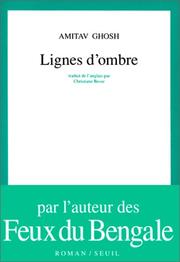 Amitav Ghosh · 1988The Shadow LinesLvl 7Slow burn
 Penelope Lively · 1987Moon TigerLvl 6Medium pace