
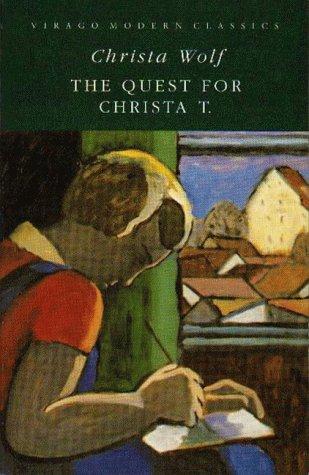
The Quest for Christa T.
Christa Wolf · 1929–2011 · Germany
Originally Nachdenken über Christa T. (German)
Why it matters
A narrator reconstructs a dead friend's thwarted, ordinary life in the young East German state. Wolf's quiet insistence on the irreplaceable single self against a regime built on collective certainty.
At a glance
Fragmented, achronological reconstruction told through scattered documents and memory.
Deep dive
A narrator assembles a dead friend's letters, sketches, and half-finished sentences into something like a portrait, and keeps admitting, in the telling, how much of a single life this method can't actually recover.
Written for readers who have finished the book. No plot recap, and nothing here is safe to read first.
Themes & symbolism
Wolf's narrator never claims to be writing a biography. She's assembling Christa T. out of diary fragments, remembered conversations, a college essay, a habit of doodling wheels in the margins of notebooks, and she keeps the seams visible: this quotation is invented, that scene is reconstructed from a single remembered detail, this gap simply can't be filled. The famous line she returns to, the difficulty of saying I, names both Christa T.'s struggle to hold onto a self the new East German state kept asking its citizens to fold into a collective we, and the narrator's own struggle to speak for a friend whose interior life she can only approach from outside.
Christa T. isn't a dissident in any dramatic sense. She teaches, marries a veterinarian, raises children, starts a novel she never finishes, and her resistance to full absorption into socialist collective identity shows up in small, almost private refusals: a diary entry, a long walk alone, an ordinary reluctance to let her particular consciousness be smoothed into anyone else's certainty. Wolf published this in 1968, and its quiet insistence that an individual's ungovernable interior life mattered, even inside a state theoretically organized around the collective good, was itself read in the GDR as a political position, one contentious enough that the book's print run was restricted.
A House Built Against the Clock She Doesn't Know Is Running
Late in the novel Christa T. and her family build a house in the countryside, an ordinary, hard-won project of foundations and beams and a room finally her own, and Wolf lets it read at first as the settled life she's been circling toward for the whole book. The irony only lands in retrospect: the house nears completion just as her diagnosis does, so the one space she's built explicitly to hold her own particular self arrives at almost exactly the moment illness makes clear how little time she'll actually get to live in it, a coincidence Wolf never underlines because the novel has already taught the reader not to expect life to arrange itself into that kind of meaning.
The last seal: what actually happens, and why it lands the way it does.
The ending, explained
Christa T. dies of leukemia not long after the house is finished, and Wolf refuses to give the narrator, or the reader, any tidy last words to organize the loss around. The novel ends instead on the narrator's continuing uncertainty about what she has actually managed to reconstruct: whether Christa T. is more present in these assembled fragments than she would be in a conventional, confident biography, or whether the whole method has just proven how much of another person is permanently unreachable once they're gone. That refusal to resolve its own project is the book's last and most honest move, a quest that ends by admitting it was never going to fully arrive.
Where to go next
 Christa Wolf · 1983CassandraLvl 7Slow burn
 Ingeborg Bachmann · 1971MalinaLvl 8Slow burn
 Elfriede Jelinek · 1983The Piano TeacherLvl 7Slow burn
 Nawal El Saadawi · 1975Woman at Point ZeroLvl 3Fast paced
 Simone de Beauvoir · 1954The MandarinsLvl 6Slow burn
 Jenny Erpenbeck · 2015Go, Went, GoneLvl 5Medium pace