
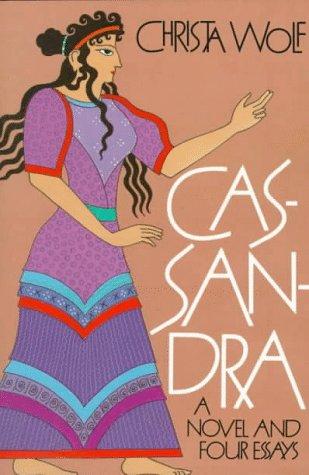
Cassandra
Christa Wolf · 1929–2011 · Germany
Originally Kassandra (German)
Why it matters
The doomed Trojan prophetess narrates the fall of Troy from a position of clear-eyed, unheeded knowledge. Wolf's retelling doubles as a veiled meditation on East German state repression and the silencing of dissenting women.
At a glance
A single dense interior monologue fusing myth, politics, and prophecy without chapter breaks.
Deep dive
Why Wolf lets her prophetess narrate an entire life in the hours before her own death, and what it means that the war she foresaw was fought over a woman who, in this telling, was never even at Troy.
Written for readers who have finished the book. No plot recap, and nothing here is safe to read first.
Themes & symbolism
Wolf sets the whole novel inside the hours before Cassandra's death at Mycenae, a slave now to Agamemnon after Troy's fall, and lets her narrate backward from that fixed point rather than forward through suspense: we know from the first page that no warning will save her, so the interest shifts entirely to what it cost her to keep telling the truth to a citadel that had already decided not to hear it.
Wolf follows the ancient counter-tradition, older than Homer, that Helen was never actually inside Troy's walls at all, a phantom substituted for political convenience, and builds her real argument on that premise: Priam's council maintains the war publicly as a fight over a woman while privately pursuing control of the trade routes through the Hellespont, a manufactured cause dressed up as a private grievance. Cassandra's curse is simply that she keeps seeing the difference between the official reason and the actual one.
Exiled from the citadel as her warnings go unheeded, Cassandra gravitates to the caves along the river Scamander, home to a shadow community of women, deserters, and foreign slaves living outside Troy's official order entirely. Wolf builds this settlement as the novel's real alternative to the doomed patriarchal city, the only place Cassandra ever experiences anything like freedom, and it exists, tellingly, entirely beyond the walls she was born inside.
Cassandra's gift is inseparable from her position inside Troy's religious hierarchy: trained by the priest Panthous into the Apollo cult that later brands her a liar, she is punished less for false prophecy than for reading the palace's own machinery too clearly once she has been let inside it. Wolf makes the curse political before it is supernatural, a woman useful to the priesthood only for as long as her visions could still be managed.
Arisbe and Myrine, an Order Troy Never Sanctioned
Among the cave-dwellers along the Scamander, Cassandra finds mentors and equals the palace never offered her: Arisbe, an older woman with a clearer eye than anyone on Priam's council, and Myrine, an Amazon fighter with no use for the marriage economy structuring every other woman's life in the story. Wolf builds the caves as a working alternative rather than a symbolic one, women organizing food, defense, and judgment among themselves, proof that the palace's exclusions were never natural law, only policy.
A Prophetess Writing from Behind the Wall
Wolf delivered an early version of this novel as the Frankfurt poetics lectures and published it in East Germany in 1983, where a woman punished for telling a citadel truths it did not want to hear, locked out, discredited, relabeled as unstable, read transparently to contemporaries as a parable for dissident writers and unheeded women under a surveillance state that treated disagreement as a symptom. Wolf never names East Germany once, and the omission is the point: she had spent her adult life watching exactly this mechanism, agreement mistaken for sanity, operate around her.
The last seal: what actually happens, and why it lands the way it does.
The ending, explained
Cassandra narrates her death as already settled before the novel even opens: Clytemnestra will kill her alongside Agamemnon that same day, and rather than plead or run she spends her final hours doing the one thing Troy never let her finish, speaking her own account without anyone empowered to silence it. She refuses the numbness that would let her not feel the blade coming, choosing full consciousness of her own death exactly as she once insisted on full consciousness of Troy's coming fall, even though both cost her everything she had. Wolf grants her no rescue and no last-minute vindication, only the narrow, hard-won victory of narrating herself, at last, on her own terms, in the minutes prophecy always told her were her last.
Where to go next
 Christa Wolf · 1968The Quest for Christa T.Lvl 7Slow burn
 Ingeborg Bachmann · 1971MalinaLvl 8Slow burn
 Elfriede Jelinek · 1983The Piano TeacherLvl 7Slow burn
 Nawal El Saadawi · 1975Woman at Point ZeroLvl 3Fast paced
 Simone de Beauvoir · 1954The MandarinsLvl 6Slow burn
 Jenny Erpenbeck · 2015Go, Went, GoneLvl 5Medium pace