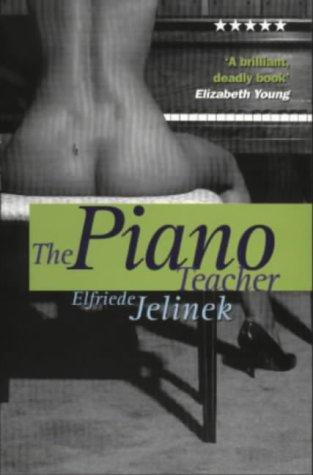
The Piano Teacher
Elfriede Jelinek · b. 1946 · Austria
Originally Die Klavierspielerin (German) · translated by Joachim Neugroschel
Why it matters
Erika Kohut, nearing forty and still sharing her mother's bed, polices her students by day and haunts peep shows by night, until a student decides to love her. The most unflinching novel ever written about repression's machinery, and Jelinek's masterpiece.
At a glance
Cold, punning, register-shifting narration and scenes of sexual cruelty that spare the reader nothing.
Deep dive
Erika Kohut has spent forty years having her body and ambition managed by her mother; what happens when a student's desire finally asks her to manage her own.
Written for readers who have finished the book. No plot recap, and nothing here is safe to read first.
Themes & symbolism
Jelinek, herself a conservatory-trained pianist raised by a possessive mother, builds Erika as a body that has been fully colonized in the name of art: the shared bed with the mother, the vetted wardrobe, the confiscated wages, all justified as protecting a "talent" that functions less as a gift than as the mother's leash. Because desire was never permitted a normal channel, it resurfaces displaced and joyless — peep-show booths, razor cuts administered with clinical precision, a voyeurism that watches without wanting to be touched. The novel insists these aren't perversions layered onto an otherwise healthy woman; they're the only shapes desire could take once every other outlet was sealed off in childhood.
Walter Klemmer's infatuation looks, at first, like the plot offering Erika an escape route, a normal romance with a charming, talented younger man. Jelinek detonates that expectation with the letter: Erika, asked to want something, can only produce an exhaustive bureaucratic script of bondage, humiliation, and beatings, love translated into the only grammar her upbringing left her — domination and submission, administered like a lesson plan. The prose stays cold and aphoristic even at its most extreme moments, larding violence with puns and clinical vocabulary, a style that refuses the reader easy sympathy for Erika and equally refuses to let her cruelty toward her students, or herself, be read as simple villainy. It's a critique aimed at the whole apparatus of respectable Viennese high culture that produced her, not just at one damaged woman.
Music as Discipline, Not Liberation
The conservatory, which ought to be the novel's one space of freedom, is instead where Erika does her own controlling — needling students for imprecision, planting glass in a rival pupil's coat pocket, treating musical mastery as a system of correct answers rather than expression. Jelinek refuses the cliché that art redeems its practitioners; here it's simply another mechanism of control, passed down like the mother's grip, from teacher to student the way it was once passed from mother to daughter.
The last seal: what actually happens, and why it lands the way it does.
The ending, explained
Enraged rather than aroused by Erika's letter — he wanted a lover, not a script to perform — Klemmer returns to her apartment and beats and rapes her, a scene Jelinek writes as a brutal inversion of what Erika had actually asked for: she'd wanted controlled submission, choreographed and consensual even in its extremity; what she gets is uncontrolled, real violation, with no possibility of reading it as her fantasy fulfilled. The novel refuses any cathartic revenge plot in response. The next day Erika arms herself with a kitchen knife and sets out toward the conservatory with some unformed idea of confronting Klemmer, but at the last moment turns the blade on herself, a single controlled stab to her own shoulder rather than the violence she'd contemplated toward him or a more serious self-destruction. She then simply walks home, bleeding, back toward the apartment and the mother she was never able to leave — an ending that grants no liberation, no reckoning, nothing but the same closed loop resuming.