
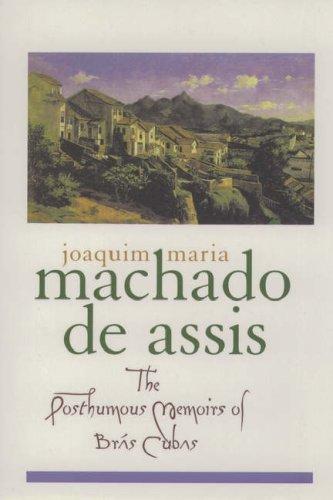
The Posthumous Memoirs of Brás Cubas
Machado de Assis · 1839–1908 · Brazil
Originally Memórias Póstumas de Brás Cubas (Portuguese)
Why it matters
A dead man narrates his own useless life with mordant, digressive glee, dedicating the book to the first worm to gnaw his corpse. Startlingly modern comedy from nineteenth-century Rio.
At a glance
Digressive, fourth-wall-breaking chapters narrated by a dead man defy linear reading habits.
Deep dive
Why a novel dedicated to a worm insists on interrupting itself constantly, and what its narrator's habit of contradicting his own excuses is really doing.
Written for readers who have finished the book. No plot recap, and nothing here is safe to read first.
Themes & symbolism
Death is Machado's narrative technology, not just his premise: because Brás Cubas is already dead, he owes the living nothing — no consistency, no modesty, no plot. He can boast of a cruelty in one chapter and disown it in the next, confess a vanity and then admire himself for confessing it, because a corpse has no reputation left to protect. The famous 'delirium' chapter, in which the dying Cubas rides a hippopotamus through the ages and watches Pandora unwrap centuries from a box, isn't a set piece so much as the novel's thesis in miniature: history is not progress, it's the same vain species repeating its follies with fancier props each century.
Quincas Borba's 'Humanitism' — the mock-philosophy that every individual's suffering is justified because it feeds the abstract god-principle Humanitas, and that even the potato exists to be eaten by man so that man may go on serving Humanitas — is Machado's parody of the era's imported certainties, Positivism and Social Darwinism alike, dressed as a system grand enough to explain everything and therefore explaining nothing. Virgília, meanwhile, is the novel's only sustained tenderness and its clearest casualty of respectability: Brás loves her precisely because adultery costs him nothing he values, and the narrative's refusal to punish either of them for it, in a century of novels that punished adulteresses reflexively, is itself a quiet act of demolition.
The 'Blank' Chapter and the Machinery of Digression
Chapter CXXXVI, titled simply 'How I Did Not Get to Be Minister,' is famously reduced by Cubas to a single sentence claiming the whole story isn't worth telling — a joke about narrative economy that is itself a small essay on vanity, since of course he has just spent chapters on far less. Elsewhere he addresses the reader directly to complain about the reader, threatens to end a chapter early out of spite, and at one point dedicates an entire aside to arguing that his book should be read the way clouds are watched, without any obligation to follow a shape. The digressiveness isn't Sterne pastiche for its own sake — Machado is building a narrator whose only real subject is his own performance of narrating, which is the most honest thing a self-satisfied nobody could possibly offer a reader.
A Nineteenth-Century Novel Rediscovered in the Twentieth
For most of the twentieth century Machado was a titan almost entirely inside Brazil, barely translated and unknown to the English-language canon that had long since absorbed Flaubert and Dostoevsky. That changed largely through a slow drip of translations and, decisively, Susan Sontag's 1990 essay campaigning for him as one of world literature's great buried writers — comparing him, without much exaggeration, to Sterne and Kafka combined a half-century ahead of schedule. The case is now close to settled: a novel this structurally unruly and psychologically merciless, written in 1881 by a mixed-race, epileptic grandson of freed slaves working as a civil servant in Rio, reads less like a period curiosity than something that simply arrived a hundred years early.
The last seal: what actually happens, and why it lands the way it does.
The ending, explained
In his final chapters, dead Brás Cubas draws up a literal balance sheet for his life, tallying what he gained against what he lost across his mediocre ambitions, his failed bid at a ministry post, his long comfortable affair, his idle inventions (an anti-melancholy plaster that never sold). None of it nets out to much either way — which is the point, since the whole memoir has been demonstrating that a comfortable bourgeois life generates almost no consequence at all, for better or worse. His final accounting produces one surplus he's willing to call a profit: he leaves no descendants, and so passes on to no one the 'small aggregate of miseries' that is human existence. It's a punchline built to deflate every value the nineteenth-century novel usually cashes out at its close — love rewarded, ambition fulfilled, legacy secured — replaced by a dead man's shrug that not existing, or not continuing to exist through children, was the only real mercy available to him.
Where to go next
 Machado de Assis · 1899Dom CasmurroLvl 6Medium pace
 Laurence Sterne · 1759The Life and Opinions of Tristram Shandy, GentlemanLvl 9Slow burn
 Denis Diderot · 1796Jacques the FatalistLvl 6Slow burn
 Graciliano Ramos · 1938Barren LivesLvl 6Slow burn
 Johann Wolfgang von Goethe · 1774The Sorrows of Young WertherLvl 3Medium pace
 John Barth · 1968Lost in the FunhouseLvl 7Slow burn