
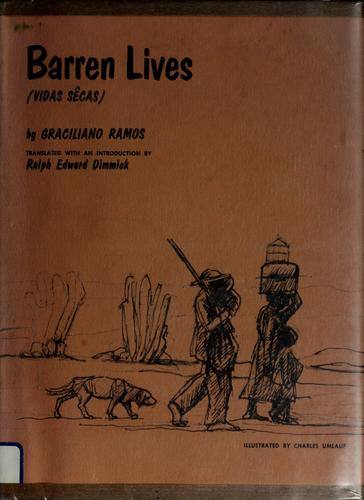
Barren Lives
Graciliano Ramos · 1892–1953 · Brazil
Originally Vidas Secas (Portuguese) · translated by Ralph Edward Dimmick
Why it matters
A family flees the Brazilian sertão's catastrophic drought in prose pared down to match the parched land itself. Social realism at its most formally exacting, and a landmark of Brazilian regionalist fiction.
At a glance
Pared-down, interiorized prose shifts close among family members' limited consciousness.
Deep dive
Why the family's dog gets a whole chapter of interior life and most of the humans barely get names.
Written for readers who have finished the book. No plot recap, and nothing here is safe to read first.
Themes & symbolism
Ramos writes poverty as a condition of language itself: Fabiano thinks mostly in single words and half-formed grievances, rehearsing a demand for higher wages he can never actually voice to the fazendeiro, because the drought that starves his land has starved his vocabulary along with it. Only Fabiano and his wife, Sinha Vitória, are named with any consistency; their two sons go through most of the novel as "the older boy" and "the younger boy," a withholding that isn't authorial carelessness but the book's argument in miniature — a society that denies a family land, food, and dignity also denies its children the individuation a name implies, and it's telling that the family's dog, Baleia, is the one member of the household the novel bothers to name and grant a mind of her own.
The novel's episodic chapters function almost as separate parables rather than links in a plot — a Christmas ruined by a stolen, half-cooked parrot; Sinha Vitória's aching, denied wish for an actual leather bed instead of the family's cowhide mats — and that fragmentation is deliberate: drought doesn't produce a story with rising action, it produces a cycle. The novel ends where it essentially began, the family packing what little they own and walking the road again toward another unnamed destination after barely surviving one more dry season, with nothing resolved and no reason within the book's world to expect the next cycle to end differently — a structural refusal of catharsis that doubles as a political charge against a region, Brazil's Northeast, whose recurring famines were treated by the state as weather rather than policy failure.
Baleia's Death and the Limits of Human Grief
The novel's most famous chapter is narrated from inside the dying consciousness of Baleia, shot by Fabiano on suspicion of rabies, her fading perception drifting toward a dream of a paradise full of rabbits to chase. Critics have long noted that the family mourns her more openly and completely than they mourn each other or their own suffering — not because they love the dog more, but because grief for an animal is a grief poverty and chronic hardship haven't yet taught them to suppress. Ramos grants Baleia the interior richness he withholds from the human sons; the effect isn't sentimental so much as accusatory, measuring exactly how much of the family's own humanity their circumstances have worn away.
A Vocabulary as Narrow as the Sertão
Ramos, a journalist and obsessive reviser, stripped the prose of ornament until sentences move in the same short, blunted rhythm as Fabiano's own thinking — few adjectives, minimal subordination, description pared back to bare fact. It's a formal choice that mirrors its subject with unusual discipline: a novel about deprivation written in deliberately deprived language, and one of the clearest examples in Brazilian regionalist fiction of style used as argument rather than decoration.
Where to go next
 Graciliano Ramos · 1934São BernardoLvl 6Medium pace
 Rachel de Queiroz · 1930The FifteenLvl 3Medium pace
 Clarice Lispector · 1977The Hour of the StarLvl 7Slow burn
 Jorge Amado · 1958Gabriela, Clove and CinnamonLvl 3Fast paced
 João Guimarães Rosa · 1956The Devil to Pay in the BacklandsLvl 9Slow burn
 Machado de Assis · 1899Dom CasmurroLvl 6Medium pace