
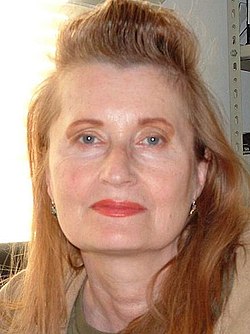
Elfriede Jelinek
Austria
Cold, punning, musical torrents: clichés wrenched inside out until ordinary Austrian speech confesses what it hides.
Jelinek was drilled from early childhood in organ, piano, and recorder toward the prodigy's career her mother had planned, studying at the Vienna Conservatory while acute anxiety made the concert stage impossible. The Piano Teacher (1983) hands that biography to Erika Kohut (approaching forty, sharing her mother's bed, policing her students) and follows it into the dark.
From the start she was a language-first writer: montage, puns, and advertising cadences turned against themselves in novels like Lust and The Children of the Dead, and in a torrent of plays flaying Austria's buried Nazism, Alpine kitsch, and sexual violence.
The 2004 Nobel honored her 'musical flow of voices and counter-voices'; citing social phobia, she accepted by video from Vienna, and one Academy member resigned in protest, a scandal she observed with characteristic lack of surprise.
Their books in the atlas
- 1983
 The Piano TeacherLvl 7psychological novel
Meanwhile, elsewhere
 b. 1942Péter NádasHungaryRussia & Eastern Europe · Hungary
 b. 1937Thomas PynchonUSANorth America · USA
 b. 1936Don DeLilloUSANorth America · USA
 b. 1943Marilynne RobinsonUnited StatesNorth America · United States
 b. 1943Michael OndaatjeCanada / Sri LankaNorth America · Canada / Sri Lanka
 b. 1940Maxine Hong KingstonUnited StatesNorth America · United States
If you like Jelinek, try
 1926–1973Ingeborg BachmannAustriashared movement: The Feminist Novel · kindred genres: psychological novel · both write in German
 b. 1967Jenny ErpenbeckGermanyshared movement: Contemporary World Fiction · kindred genres: psychological novel · both write in German
 b. 1942Peter HandkeAustriashared movement: Contemporary World Fiction · kindred genres: psychological novel · both write in German
 b. 1944Richard FordUnited Statesshared movement: Contemporary World Fiction · kindred genres: psychological novel
 1905–1994Elias CanettiBulgaria / UKkindred genres: psychological novel · both write in German · neighboring movements
 1881–1942Stefan ZweigAustriakindred genres: psychological novel · both write in German · neighboring movements