
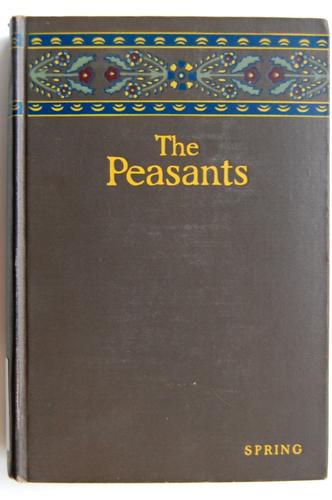
The Peasants
Władysław Reymont · 1867–1925 · Poland
Originally Chłopi (Polish)
Why it matters
One Polish village is followed through a full cycle of seasons, labor, and passion across four volumes. Naturalist precision applied at epic scale to rural life rather than the city.
At a glance
A four-volume scope and thick regional dialect complicate an otherwise linear seasonal structure.
Deep dive
A Polish village followed season by season through plowing, harvest, and a love triangle the whole community treats as a threat to the land itself.
Written for readers who have finished the book. No plot recap, and nothing here is safe to read first.
Themes & symbolism
Reymont structures the novel in four volumes named for the seasons, and that agricultural calendar isn't backdrop but argument: Lipce's plowing, sowing, harvest, and communal festivals are given the same epic weight and moral seriousness other novelists of the era reserved for the city, building a near-anthropological portrait of peasant custom, folk belief, and the village's own extralegal systems of law and punishment. Rural life here is neither pastoral idyll nor simple virtue — it's a complete, often harsh social order with its own real stakes, and Reymont is just as interested in its casual cruelty as in the dignity of its labor.
The love triangle at the novel's center — Maciej Boryna, his son Antek, and Jagna, the independent-minded young woman both men want — becomes the mechanism through which the village's real organizing principle surfaces: land, inheritance, and social role matter more than any individual's desire, and desire that threatens the orderly transmission of property through legitimate marriage is treated as an existential threat requiring collective correction. Jagna's sensuality and refusal to perform proper submissiveness make her a target of communal suspicion well before her transgressions escalate, and Reymont never lets the reader mistake the village's eventual response to her as anything but brutal, even while he clearly loves the community's rhythms and customs elsewhere in the book.
Naturalism at Epic Scale
Reymont's method draws on the era's naturalist commitment to exhaustive, documentary-precise social detail, but applies it somewhere naturalism rarely went at this length and ambition — not the industrial city but the agricultural village, with its own calendar, its own courts, its own religious and superstitious textures rendered with total seriousness. The novel's scale and precision were central to the 1924 Nobel Prize citation honoring Reymont as "the classical writer of the Polish countryside," a recognition of literary fiction's ability to grant the same weight to rural labor and custom that had long been reserved for urban and aristocratic subjects. Reymont reportedly drew on his own early years working alongside peasants and itinerant laborers before turning to writing, giving the novel's dialect and detail an ethnographic precision that later critics have compared to Zola's research methods applied to an entirely different social world.
The last seal: what actually happens, and why it lands the way it does.
The ending, explained
Boryna is fatally injured defending disputed communal land from Prussian encroachment, a death rooted so completely in the soil he spent his life working that it elevates him to something like a communal martyr, and the land itself passes on through the family's inheritance lines largely intact. Jagna's accumulated transgressions against village sexual and marital norms, meanwhile, finally exceed what the community will tolerate, and she is driven from Lipce in a brutal public shaming led by a mob of village women. The order organized around land and inheritance survives, even sanctified by Boryna's death, while the individual desire that threatened it is violently expelled — a bleak but unsentimental verdict on what rural community stability actually costs the people who don't fit its terms.
Where to go next
 Émile Zola · 1885GerminalLvl 5Medium pace
 Frank Norris · 1899McTeagueLvl 5Medium pace
 Stephen Crane · 1895The Red Badge of CourageLvl 5Fast paced
 Eça de Queirós · 1888The MaiasLvl 6Medium pace
 Joris-Karl Huysmans · 1884Against Nature (À rebours)Lvl 7Slow burn
 Honoré de Balzac · 1835Père GoriotLvl 4Medium pace