
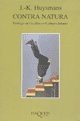
Against Nature (À rebours)
Joris-Karl Huysmans · 1848–1907 · France
Originally À rebours (French)
Why it matters
The 'breviary of the Decadence': one aesthete, no plot, and an encyclopedia of exquisite, perverse sensation: jeweled tortoises, perfume organs. It corrupted Dorian Gray and declared art's independence from nature and morality alike.
At a glance
Almost plotless, an encyclopedic catalogue of aesthetic and sensory digression.
Deep dive
Why a novel with almost no plot became the most dangerous book of the century — the one that corrupts Dorian Gray just by sitting on his shelf.
Written for readers who have finished the book. No plot recap, and nothing here is safe to read first.
Themes & symbolism
Des Esseintes's tortoise is the whole philosophy staged as a throwaway anecdote: bored by his Oriental carpet's insufficiently vivid contrast, he has the animal's shell crusted in gold and gemstones until the weight kills it. Decoration doesn't complement nature here, it murders it — the emblem for a book in which every refinement Des Esseintes pursues turns out to require something living be drained first, his own exhausted body included.
The chapters cataloguing synthetic flowers and the 'mouth organ' of liqueurs — a cabinet of spirits he plays like an instrument, curaçao standing in for clarinet, kirsch for piccolo — aren't digressions, they're the argument, delivered as inventory rather than incident: that artifice has replaced nature as the standard against which beauty gets judged. He prizes real flowers bred to look fake and rejects fake ones for failing to look real enough, a hierarchy exactly backwards from anything the Pre-Raphaelites would recognize, and precisely Huysmans's point.
His late, half-ironic drift toward Catholic ritual and a doctor's forced order back to Paris society aren't conversion or comeuppance so much as decadence recognizing its own kinship with religion — another closed system built on ornament, incense, and sensation prized for its own sake, offering the same escape from ordinary nature that his perfumes and jewels do.
The Poisonous Yellow Book
Huysmans didn't just describe a genre, he handed the next one a weapon: Oscar Wilde has Lord Henry give Dorian Gray an unnamed 'yellow book' that corrupts him over years of obsessive rereading, and generations of readers — sometimes with Huysmans's own tacit agreement — have identified it as À rebours. A novel about art's total independence from morality ended up demonstrating its own thesis by becoming, inside a greater novel, literally corrupting matter.
A Novel Against Plot
The critic Barbey d'Aurevilly's contemporary verdict — that after this book Huysmans had only 'the muzzle of a pistol or the foot of the cross' left to choose between — registers just how completely the novel had exhausted its genre by refusing incident. There's no antagonist, barely another character, and each chapter is a sealed cabinet of objects: books, paintings, perfumes, ranked and catalogued. The absence of plot is the polemic. A narrative that cares what happens next is still obeying nature's logic of cause and consequence, and Des Esseintes — and Huysmans — want out of that logic entirely.
Where to go next
 Joris-Karl Huysmans · 1891Là-BasLvl 7Slow burn
 Émile Zola · 1885GerminalLvl 5Medium pace
 Gabriele D'Annunzio · 1889The Child of PleasureLvl 6Slow burn
 Oscar Wilde · 1890The Picture of Dorian GrayLvl 4Medium pace
 Gustave Flaubert · 1857Madame BovaryLvl 5Slow burn
 Marcel Proust · 1913Swann's WayLvl 8Slow burn