
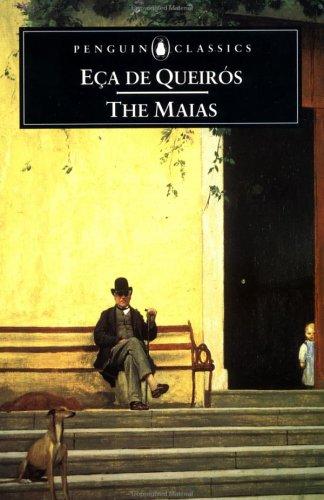
The Maias
Eça de Queirós · 1845–1900 · Portugal
Originally Os Maias (Portuguese)
Why it matters
A wealthy Lisbon family's elegant surface conceals a devastating secret unfolding across generations. Eça's masterpiece brought Zola's naturalism and Flaubert's irony to bear on Portugal's own decaying aristocracy.
At a glance
A very long, ironic, socially dense nineteenth-century family chronicle.
Deep dive
How Eça builds an entire indictment of Portuguese high society out of a young heir's talk-filled, action-empty homecoming — and why his best friend's grand literary ambitions never produce a single finished page.
Written for readers who have finished the book. No plot recap, and nothing here is safe to read first.
Themes & symbolism
Carlos da Maia is raised by his grandfather Afonso to be the great man his own weak, romantic father Pedro could never be, and the novel patiently shows the experiment failing: Carlos studies medicine, opens a fashionable practice, furnishes a beautiful house, and does almost nothing with any of it, drifting from cause to cause with the same dilettante's ease his friend Ega brings to literature. Ega talks constantly of the novel he'll write, the journal he'll found, the Portugal he'll reform, and produces nothing — the two of them are the same failure in different registers, all appetite and no completion, and Eça means them to stand for a whole class that has inherited wealth and taste but not the will to do anything with either.
Heredity is the engine under the plot, not just its ironic punchline: Pedro da Maia's romantic self-destruction over Maria Monforte, and Afonso's exile of the family name from Lisbon afterward, both return to claim Carlos exactly when he thinks he's escaped his father's fate by falling in love himself. The family's isolation — an old aristocratic line that has stopped renewing itself, stopped marrying outward, stopped producing anything but exquisite interiors and clever conversation — becomes literal when the woman Carlos loves turns out to share his blood, the closed circuit of the Maia line collapsing in on itself as the most extreme possible image of a class too inbred, in every sense, to survive.
Zola in Lisbon
Eça de Queirós spent his career as a diplomat stationed in Havana, Newcastle, Bristol, and finally Paris, which gave him the outsider's eye he trains on Lisbon throughout the novel — a city he depicts as a place where everyone imports their opinions, their furniture, and their vices from London and Paris and calls it sophistication. That vantage let him import Zola's naturalism and Flaubert's irony wholesale and apply them to Portugal specifically: Carlos is a Portuguese Frédéric Moreau, all cultivated sensibility and no achievement, and the novel's deterministic plotting — character as inherited fate, environment as destiny — is straight out of the French naturalist playbook, transplanted onto an aristocracy Eça knew intimately enough to skewer without mercy.
The result is less a Portuguese imitation of French models than an argument about Portugal itself: a country, in Eça's rendering, that has substituted talk for action so completely that its finest minds spend their energy on wit rather than reform, decorating their own decline. Ega's endless deferred masterpiece and Carlos's endless deferred vocation aren't just character flaws — they're diagnosed, in the novel's ironic register, as the national disease.
The last seal: what actually happens, and why it lands the way it does.
The ending, explained
The revelation arrives through Guimarães, who idly reconstructs the old scandal of Maria Monforte's elopement with Tancos and realizes that Maria Eduarda — the woman Carlos has been carrying on a very public affair with — is the daughter Pedro da Maia never knew he had, raised abroad and returned to Lisbon a stranger to her own family. Carlos and Maria Eduarda have already consummated the relationship; the discovery doesn't just end the affair, it retroactively poisons it, turning the novel's central romance into an incest the two lovers backed into blind. Afonso, the grandfather who staked everything on Carlos redeeming the family, dies of the shock almost immediately after.
Eça declines to end on melodrama. Years later, Carlos and Ega meet again as older men, revisit their old haunts, and talk over what became of their youth with the same fluent, self-aware irony they've always used to cushion themselves from consequence — Carlos has settled into passive, moneyed exile, ambition and love both abandoned, the Maia name effectively ending with him. The tone is wistful rather than tragic, which is the final cruelty: the two men have enough self-knowledge to see exactly how little they amounted to, and not quite enough will to have done anything else.
Where to go next
 Eça de Queirós · 1875The Crime of Father AmaroLvl 5Medium pace
 Émile Zola · 1885GerminalLvl 5Medium pace
 Stephen Crane · 1895The Red Badge of CourageLvl 5Fast paced
 Theodore Dreiser · 1900Sister CarrieLvl 4Medium pace
 Władysław Reymont · 1904The PeasantsLvl 5Slow burn
 Giovanni Verga · 1881The House by the Medlar TreeLvl 6Slow burn