
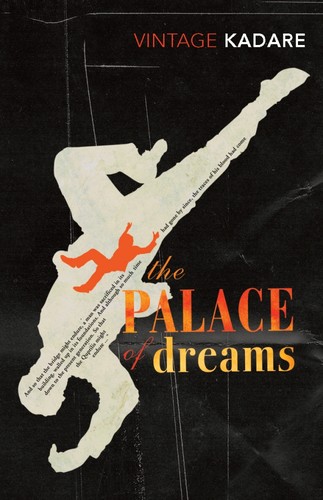
The Palace of Dreams
Ismail Kadare · 1936–2024 · Albania
Originally Pallati i Ëndrrave (Albanian)
Why it matters
A young Ottoman bureaucrat is hired to catalogue the empire's citizens' dreams, searching for signs of sedition. Kadare's Kafkaesque allegory for surveillance and thought-control was swiftly banned by Albania's own regime.
At a glance
A clear bureaucratic-nightmare plot in the Kafka mold, allegorical rather than syntactically dense.
Deep dive
A Kafkaesque bureau catalogues every dream in the empire looking for sedition — what it means that the novel's real subject is who gets to decide what a dream is telling you.
Written for readers who have finished the book. No plot recap, and nothing here is safe to read first.
Themes & symbolism
The Tabir Sarrail's premise — that the state can and should own the unconscious — pushes totalitarian surveillance to its logical extreme: if even sleep can be conscripted as evidence, there's no private interior left for a subject to retreat into. But Kadare's sharper point is about interpretation rather than collection: the bureau doesn't discover sedition in the dreams it gathers, it manufactures sedition by deciding, from above, which dream will be designated the week's 'Master-Dream' and what it will be made to mean. Meaning here isn't found, it's imposed — a dream's actual content is almost incidental next to the political convenience of whatever reading gets attached to it, which makes the whole apparatus less a science of the mind than a factory for retroactively justified purges.
Mark-Alem's rise through the bureau's departments — registration, then selection, then interpretation — tracks his slow absorption into a machine that is, unbeknownst to him at the start, capable of turning on his own family, the Quprilis, whose historical prominence in imperial service makes them permanently suspect no matter how loyally they serve. The novel is quietly obsessed with the fog of half-knowledge everyone in this system operates under — nobody, including Mark-Alem, ever seems to fully understand who is targeting whom or why, which is exactly how Kadare suggests totalitarian bureaucracies actually function: not through any single mastermind's clarity, but through a self-perpetuating machine that nobody inside it can see the whole shape of.
Writing Under Hoxha
Kadare set the novel in a lightly fictionalized Ottoman past, but nobody in Albania in 1981 mistook its real target: Enver Hoxha's Sigurimi and the all-seeing surveillance state Kadare had lived inside his entire career, a common evasive strategy among writers under Eastern Bloc censorship, who displaced contemporary critique onto safely distant historical settings to get it past the censors. It didn't work for long — the book was banned within weeks of publication. Kadare's own position mirrored Mark-Alem's precarious elevation: he was Albania's most internationally celebrated writer, periodically favored by a regime eager for cultural prestige abroad, yet never fully safe from suspicion, a status he held until defecting to France in 1990, shortly before Communism's collapse in Albania. The novel's ambivalence about whether Mark-Alem is victim or instrument reads, in that light, less like abstract allegory and more like Kadare examining his own compromised proximity to power.
The last seal: what actually happens, and why it lands the way it does.
The ending, explained
As Mark-Alem is promoted deeper into the Tabir Sarrail's hierarchy, a dream surfaces in the bureau's vaults that can be traced, ambiguously, back to a source connected to his own Quprili family — its imagery entangled with the family's own history and prominence — and this dream is selected as the week's Master-Dream, triggering the political destruction of a rival within the empire's power structure. Mark-Alem's own hands are implicated in setting that machinery in motion, whether or not he fully grasps, in the moment, what he's unleashing or against whom it might eventually turn. The novel ends with him promoted to a senior position inside the very apparatus that has just been used against people tied to his own bloodline, a chilling final image precisely because it refuses to clarify how much he understood: Kadare's point isn't that Mark-Alem is innocent or guilty, but that totalitarian systems are built to erase that distinction, absorbing even their most vulnerable, most watched subjects as instruments of their own surveillance.
Where to go next
 Ismail Kadare · 1963The General of the Dead ArmyLvl 5Medium pace
 Ismail Kadare · 1970The SiegeLvl 5Medium pace
 Ismail Kadare · 1971Chronicle in StoneLvl 4Medium pace
 Ismail Kadare · 1978Broken AprilLvl 5Medium pace
 Aleksandr Solzhenitsyn · 1962One Day in the Life of Ivan DenisovichLvl 3Fast paced
 Mikhail Sholokhov · 1928And Quiet Flows the DonLvl 5Medium pace