
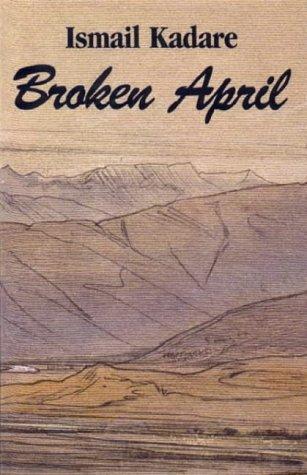
Broken April
Ismail Kadare · 1936–2024 · Albania
Originally Prilli i Thyer (Albanian)
Why it matters
A young highlander kills to avenge his brother under the Kanun's ancient blood-feud law, then has thirty days to live before the next killing claims him. Kadare's starkest anatomy of a code that outlasts the state around it.
At a glance
A spare, linear plot carries heavy ritual and legal detail that rewards careful attention.
Deep dive
A highland writer brings his new wife to the mountains to admire an ancient blood-feud code as living folklore, on the same roads where a young man is currently living out exactly what that code costs.
Written for readers who have finished the book. No plot recap, and nothing here is safe to read first.
Themes & symbolism
Gjorg Berisha kills the man who killed his brother because the Kanun, the highlands' centuries-old customary law, requires it of him, and Kadare narrates his subsequent thirty-day reprieve, the window before his own life becomes legally forfeit to the dead man's family, with the flat, procedural precision of a man walking through a bureaucracy rather than a moral crisis, because for Gjorg the Kanun has left no space for the crisis to register as a choice at all. Mark Ukacierra, the official blood-tax collector who tallies feud deaths and gathers his fee from the mountain's endless killings, is Kadare's bleakest image of what happens when an archaic code outlives the state that might once have limited it: violence here isn't chaos, it's an administered system with its own accountant.
Bessian Vorpsi, a writer, and his new wife Diana travel into the highlands on their honeymoon specifically to witness the Kanun in action, treating Gjorg's approaching death as authentic folklore worth admiring from a comfortable, moving carriage, and Kadare's harshest irony is Diana's growing fascination with Gjorg himself once she glimpses him, a real man's actual death sentence reduced, by her class and distance, to the most romantic thing she has ever seen. The honeymoon plot runs alongside Gjorg's countdown without ever quite touching it, two entirely different registers of the same mountains, one lived and one toured.
Diana's Honeymoon Souvenir
Diana's fascination with the Kanun curdles, over the course of the journey, from tourist curiosity into something closer to envy, a longing for the terrible clarity of a life whose every obligation is already written down, against her own marriage's vaguer, unresolved dissatisfactions. She questions the guides, collects details of the code the way another traveler might collect trinkets, and Kadare lets her fixation on Gjorg himself grow specific enough to be uncomfortable, a woman falling for the idea of a man's death sentence rather than for anything she actually knows about him. Bessian, meanwhile, keeps drafting an admiring book of his own about the highlands, oblivious to how closely his wife's fixation now mirrors the very romanticizing impulse his research was supposed to keep at a scholarly distance.
The last seal: what actually happens, and why it lands the way it does.
The ending, explained
Gjorg's thirty days run out with the same procedural inevitability the whole novel has insisted on: he is shot, as the Kanun requires, by a member of the family whose earlier death he avenged, the cycle simply resetting onto whichever male relative inherits his own family's obligation to avenge him in turn. Bessian and Diana, meanwhile, pass close enough to witness some of the code's machinery firsthand without ever being touched by its actual cost, and their honeymoon ends with Diana unsettled in a way she cannot fully name, having wanted proximity to a death she was always going to be allowed to simply drive away from. Kadare's closing juxtaposition is deliberately merciless: the Kanun's victims live inside a closed system with no exit, while its admirers get to leave whenever the scenery stops being picturesque.
Where to go next
 Ismail Kadare · 1963The General of the Dead ArmyLvl 5Medium pace
 Ismail Kadare · 1970The SiegeLvl 5Medium pace
 Ismail Kadare · 1971Chronicle in StoneLvl 4Medium pace
 Ismail Kadare · 1981The Palace of DreamsLvl 5Medium pace
 Aleksandr Solzhenitsyn · 1962One Day in the Life of Ivan DenisovichLvl 3Fast paced
 Mikhail Sholokhov · 1928And Quiet Flows the DonLvl 5Medium pace