
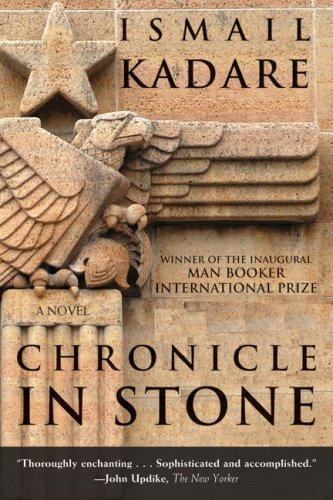
Chronicle in Stone
Ismail Kadare · 1936–2024 · Albania
Originally Kronikë në gur (Albanian)
Why it matters
A boy's-eye view of Gjirokastër as Italian occupation, air raids, and rumor pass through a hill town that has already outlasted every empire before this one. Kadare's own childhood transposed into his warmest, funniest novel.
At a glance
An episodic, child's-eye narrative keeps the wartime chaos legible.
Deep dive
A boy grows up inside a hill town so old it has already survived Ottomans, Greeks, and every other occupier history sent it, and Kadare lets a child's confused wonder carry what a grimmer narrator would have made unbearable.
Written for readers who have finished the book. No plot recap, and nothing here is safe to read first.
Themes & symbolism
Gjirokastër's stone houses, cisterns, and citadel give the unnamed boy narrator a physical world stable enough to absorb the occupation, the air raids, and the town's rotating cast of occupying armies, Italian, then Greek, then German, as one more layer of a place that has already outlasted centuries of exactly this kind of disruption. Kadare keeps the register genuinely comic as often as grim: the boy's fascination with the giant cistern under his own house, imagined as a lair for whatever monster his fear needs it to hold that week, sits alongside real bombing raids and a captured English airman without the tonal shift feeling like a failure of seriousness, because that is exactly how a child metabolizes catastrophe, as adventure first and only slowly, retrospectively, as history.
Xhexho, the town's roaming purveyor of rumor, and the household of old women who track births, deaths, and omens with the same authority the state claims for its official announcements, give the town its real information network, one that outlasts and frequently outperforms whichever occupying power currently controls the radio and the newspapers. Kadare drew the novel directly from his own Gjirokastër childhood, and that autobiographical closeness is what lets the book hold genuine warmth toward a town under bombardment without ever pretending the war wasn't actually happening to it.
The Cistern as the House's Second War
The boy's imagination stages its own private campaign in the water cistern beneath his family's floorboards, populating it with witches and monsters he half believes in, a fear he can approach, name, and eventually master on his own terms in a way the actual war overhead never allows him to. Kadare lets the two wars run in parallel through the whole book, the cistern's imagined dangers giving the boy a scale of catastrophe he can handle, right up until the real bombing raids grow frequent enough to outstrip anything the cistern could offer him. The cistern doubles, too, as the town's literal shelter once the raids intensify, so the boy's private mythology and the street's actual survival strategy end up sharing the same hole in the ground.
The last seal: what actually happens, and why it lands the way it does.
The ending, explained
The war eventually reaches directly into the boy's own family and street, casualties and destruction accumulating past the point where a child's imaginative reframing can keep them at arm's length, and by the novel's last chapters the citadel and cisterns that once seemed like permanent, protective ancient fixtures are shown to be exactly as vulnerable as everything built more recently around them. Kadare declines to end on liberation or resolution in any conventional sense; the town's occupiers change flags one more time, as they have for centuries, and the narrator's chronicle simply stops rather than concludes, its real argument being that Gjirokastër's stones have absorbed this cycle before and will absorb it again, indifferent to which empire currently claims them.
Where to go next
 Ismail Kadare · 1963The General of the Dead ArmyLvl 5Medium pace
 Ismail Kadare · 1970The SiegeLvl 5Medium pace
 Ismail Kadare · 1978Broken AprilLvl 5Medium pace
 Ismail Kadare · 1981The Palace of DreamsLvl 5Medium pace
 Aleksandr Solzhenitsyn · 1962One Day in the Life of Ivan DenisovichLvl 3Fast paced
 Mikhail Sholokhov · 1928And Quiet Flows the DonLvl 5Medium pace