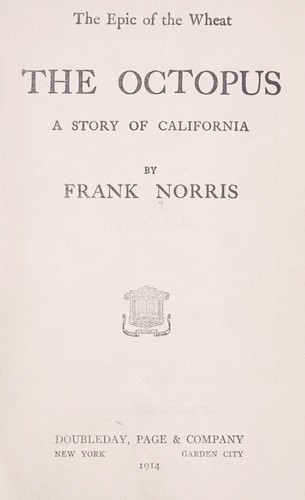
The Octopus: A Story of California
Frank Norris · 1870–1902 · United States
Why it matters
Wheat farmers in California's San Joaquin Valley are crushed under a railroad monopoly's freight rates and political machine. The first volume of Norris's unfinished Epic of the Wheat, naturalism scaled to continental economics.
At a glance
A large cast and heavy economic detail across a sprawling, deterministic plot.
Deep dive
Why Norris gives the San Joaquin wheat ranchers every reason to hate the railroad crushing them, then spends his real argument on how little the wheat itself notices either side of that fight.
Written for readers who have finished the book. No plot recap, and nothing here is safe to read first.
Themes & symbolism
The octopus of the title is the Pacific and Southwestern Railroad, its rate-fixing and land-grabbing tentacles reaching literally into the ranchers' lives: freight rates set high enough to strip profit the instant a harvest succeeds, land titles the railroad sold once and now reclaims once the acreage is proven valuable. Norris builds Magnus Derrick, Annixter, and the other ranchers around Bonneville as men convinced their grievance is simple and their cause therefore just, and the novel spends its length dismantling that certainty without ever excusing the railroad's cruelty.
Norris's real subject, laid out through the poet Presley's slow disillusionment, is Force: an impersonal, indifferent power that runs through the wheat's growth exactly as it runs through the railroad's expansion, so that ranchers and company alike are instruments of the same process rather than opposed moral agents. Vanamee, the shepherd mystic mourning his vanished love Angele, supplies the novel's other register, a strand of near-occult renewal, his telepathic calling across the plain, answered years later by Angele's daughter, that argues the wheat's cycle continues past any single human tragedy, which is less comfort than indictment.
The Mussel Slough Tragedy, Rewritten
Norris built the climactic irrigation-ditch confrontation directly from the Mussel Slough gunfight of 1880, when Tulare County ranchers and a federal marshal serving eviction notices for the Southern Pacific Railroad exchanged fire, leaving seven men dead. Norris moved the setting north to a fictionalized Bonneville, kept the essential shape of ranchers defending land they believed the railroad had promised them, and used the documented history to insulate the novel's most violent scene from any charge of melodrama: the massacre in the book is, if anything, a restrained version of what actually happened.
Presley's Poem Against Presley's Novel
Presley, the resident poet who arrives at the Derrick ranch hoping to write the epic of the West, produces a popular protest poem inspired by a Millet-like painting of an exhausted farmhand, and watches it become a bestselling sensation completely disconnected from the specific ranchers whose ruin inspired it. Norris uses Presley's hollow literary triumph to needle his own project: a novel this determined to indict the railroad by name still can't guarantee its readers will feel anything more useful than the same abstracted, safely distant sympathy Presley's poem produces.
The last seal: what actually happens, and why it lands the way it does.
The ending, explained
The ranchers' confrontation with the marshal and the railroad's hired men at the irrigation ditch leaves Annixter, Hooven, and several others dead within minutes, the promised land title fight settled by rifle fire rather than any court. S. Behrman, the railroad's local agent and the novel's most concentrated villain, survives the shooting only to die weeks later in a scene Norris stages as pure poetic justice: inspecting a grain ship loading San Joaquin wheat for famine relief in India, Behrman falls into the hold as the chute opens, and the wheat that ruined the ranchers who grew it buries him alive, indifferent to his death exactly as it was indifferent to their ruin. Norris closes on that same wheat reaching India months later, filling stomachs an ocean away from the graves it paid for, the Force that drives the whole book completing its cycle without once pausing to notice who it served or who it crushed.