
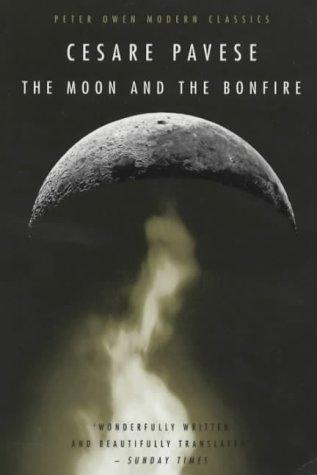
The Moon and the Bonfires
Cesare Pavese · 1908–1950 · Italy
Originally La luna e i falò (Italian)
Why it matters
An emigrant returns from America to his Piedmont village to find the war has scarred everything he came home for. Pavese's final novel makes the impossibility of return into aching lyric, published months before his suicide.
At a glance
Nonlinear memory-driven structure and elliptical dialogue obscure a simple plot.
Deep dive
What Anguilla actually finds waiting for him when he returns rich from America to the Piedmont hills he spent his whole exile idealizing.
Written for readers who have finished the book. No plot recap, and nothing here is safe to read first.
Themes & symbolism
Pavese gives his narrator no name beyond Anguilla, 'the Eel,' a nickname from his hardscrabble youth as a foundling farmhand, and structures the whole novel as a return that keeps failing to deliver the reunion it promises: the farm, the family, the girl he half-loved as a boy, all exist now mostly as absence, replaced or destroyed by the years he spent away in California. The bonfires of the title, an old peasant custom of burning brush to enrich the soil, become Pavese's central figure for a violence that recurs on the landscape without ever really being resolved by it: burn enough of the old growth and something grows back, but never the same thing.
Nuto, the childhood friend Anguilla keeps returning to for information he mostly doesn't want, functions as the novel's reluctant historian, doling out what actually happened to the people Anguilla left behind in fragments delivered more from obligation than eagerness. That reluctance is the point: Pavese, writing months before his own death, builds a Piedmont where nobody who stayed through the war wants to be the one who says out loud what the war actually cost the valley. Anguilla's own status as a foundling, a child the valley took in without ever fully claiming as its own, sharpens the return further: he is asking a home that was always somewhat conditional to account for losses it would rather let a returning outsider simply not notice.
The Emigrant Who Translated Melville Comes Home
Pavese spent years translating Moby-Dick and other American fiction into Italian, work that shaped his own prose long before he sent a character to California and back, and The Moon and the Bonfires reads in places like his settling of accounts with that other literature: Anguilla's America is barely rendered at all, a blank the narrator can't animate the way he can every field and farmhouse of the valley, as if Pavese's own fluency in American writing couldn't translate into fluency in American experience. That imbalance is exactly right for the book's argument: the valley Anguilla actually knows in his body, not the country he spent years earning money in, is the only place capable of costing him anything when he finally has to reckon with it.
The last seal: what actually happens, and why it lands the way it does.
The ending, explained
Nuto finally tells Anguilla what happened to Santina, the farmer's rebellious younger daughter Anguilla had once half-loved from a distance: caught up in the chaos of the war's final year as, depending on which side you believed, an informer or a double agent, she was shot by partisans and her body burned, the valley settling its own accounts the way it always has, with fire on the hillside rather than with any process Anguilla would recognize as justice. Pavese ends the novel almost immediately after, offering no scene of grief, only Anguilla's flat recognition that the home he'd spent America idealizing had gone on being exactly as merciless as the place he'd fled, just with different names attached to the cruelty.
Where to go next
 Cesare Pavese · 1949The House on the HillLvl 5Slow burn
 Alberto Moravia · 1951The ConformistLvl 5Medium pace
 Luigi Pirandello · 1904The Late Mattia PascalLvl 5Medium pace
 Italo Svevo · 1923Zeno's ConscienceLvl 6Medium pace
 Antonio Tabucchi · 1994Pereira MaintainsLvl 4Medium pace
 Gabriele D'Annunzio · 1889The Child of PleasureLvl 6Slow burn