
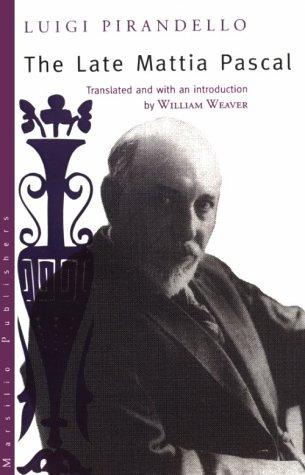
The Late Mattia Pascal
Luigi Pirandello · 1867–1936 · Italy
Originally Il fu Mattia Pascal (Italian)
Why it matters
A man mistakenly declared dead seizes the freedom to invent a new identity, and discovers that a self with no fixed name or past is its own kind of prison. Pirandello's first great meditation on the instability of identity.
At a glance
Wry, digressive first-person voice wrapped around a destabilizing premise.
Deep dive
Pirandello's real punchline: a man handed the rarest freedom imaginable — a legal identity of his own invention — discovers that a self with no paperwork behind it has nowhere to stand at all.
Written for readers who have finished the book. No plot recap, and nothing here is safe to read first.
Themes & symbolism
Mattia's windfall and the misidentified corpse hand him something almost no one gets — legal death with the body still walking around — and Pirandello uses it to test what a self actually consists of once the paperwork is stripped away. Adriano Meis has no debts, no wife, no history, and turns out to have no standing either: he can't press charges when he's robbed, can't marry, can't be legally anyone, because personhood in Pirandello's world isn't an interior fact but a set of registrable claims other people recognize. Freedom without a fixed social identity isn't freedom, it's just a different kind of confinement, one with no walls to see.
The novel doubles Mattia against Adriano and then against the Mattia who returns, and none of the three ever fully cohere into one person — each is provisional, contingent on whichever papers happen to describe him at the time. Even the near-rhyme between Adriana, the woman Adriano falls for, and Mattia's abandoned wife suggests the self keeps replaying its own plot no matter what name it's wearing. This is Pirandello rehearsing, a decade early, the idea he'd later stage literally in Six Characters in Search of an Author: identity as a performance assembled from outside, not a fixed truth held within.
Two deaths, one body
Mattia effectively dies twice — once by clerical error, once by his own staged suicide as Adriano — and neither death touches the actual, living man, who ends the book visiting his own grave as a spectator. The gap between the paperwork and the person is the novel's whole architecture: bureaucracy declares facts about him that his continued existence can't override, and every attempt to correct the record only produces a new, equally provisional identity rather than restoring the original one.
A dry run for the theater
The premise — a man with no fixed self, forced to watch others assign him identity after identity — is essentially the engine Pirandello would later put onstage literally, with characters demanding an author fix their story once and for all. Mattia Pascal is the novelistic first draft of that lifelong obsession: identity as something imposed and contested from outside, never simply possessed.
Pirandello also uses Mattia's narration itself as evidence for the theme rather than just a vehicle for it: Mattia tells his own story wryly, at a remove, aware that he is composing a version of events rather than simply reporting them, which means the novel's first-person voice is already performing the same instability it describes. A narrator who can't fully trust his own account of his two deaths and one life is the formal proof of the book's argument, not just its illustration.
The last seal: what actually happens, and why it lands the way it does.
The ending, explained
Adriano Meis's freedom collapses once he can't marry Adriana or even report being robbed, so Mattia fakes Adriano's suicide by a canal and walks back into his hometown as Mattia Pascal, only to find his wife has remarried and rebuilt a life with no room left for a returning husband. The town treats his survival less as a miracle than an administrative inconvenience to be filed away. He ends up visiting his own tombstone, technically alive, legally reinstated, and socially nowhere — belonging neither to the identity he shed nor to the one he reclaimed, a permanent outsider to his own biography. Pirandello leaves him there, in the cemetery, rather than granting any final reintegration, because the whole point of the book is that there's no form left for him to reintegrate into.
Where to go next
 Luigi Pirandello · 1926One, No One and One Hundred ThousandLvl 6Slow burn
 Leonardo Sciascia · 1961The Day of the OwlLvl 4Fast paced
 Grazia Deledda · 1913Reeds in the WindLvl 4Medium pace
 Giovanni Verga · 1881The House by the Medlar TreeLvl 6Slow burn
 Alessandro Manzoni · 1827The BetrothedLvl 5Medium pace
 Italo Svevo · 1923Zeno's ConscienceLvl 6Medium pace