
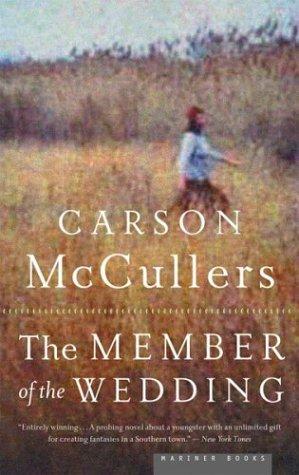
The Member of the Wedding
Carson McCullers · 1917–1967 · United States
Why it matters
A lonely twelve-year-old tomboy becomes fixated on her brother's wedding as her own ticket out of isolation. McCullers's compact, aching study of adolescent longing to belong to something larger than oneself.
At a glance
Close, claustrophobic interiority inside a lonely adolescent's mind.
Deep dive
Why a lonely twelve-year-old decides her brother's wedding is actually happening to her, and what it takes for the people who love her to talk her out of getting on that honeymoon car.
Written for readers who have finished the book. No plot recap, and nothing here is safe to read first.
Themes & symbolism
Frankie Addams spends the summer before her brother Jarvis's wedding in a state of acute, motherless loneliness, drifting between the kitchen where the family's cook Berenice Sadie Brown holds court and the yard where her six-year-old cousin John Henry West tags along, belonging fully to neither. McCullers gives Frankie's isolation a precise, almost linguistic shape: Frankie invents the phrase the we of me to describe the belonging she's certain she's never had, and fixes, with a twelve-year-old's totalizing logic, on Jarvis's wedding as the place that belonging will finally arrive.
Berenice, who has outlived three husbands and buried more grief than she ever narrates directly, tries repeatedly to talk Frankie out of her plan to join the newlyweds on their honeymoon, not by dismissing the loneliness but by naming her own version of it, a rare instance in Southern fiction of this period letting a Black domestic worker's interior life carry equal narrative weight to the white child she serves. McCullers builds the whole novel's structure around the three of them, Frankie, Berenice, John Henry, talking in the kitchen as if conversation alone might be strong enough to hold off what's coming.
The wedding, when it finally arrives, is barely on the page for more than a scene, because McCullers has spent the entire novel making clear that the ceremony itself was never going to be able to satisfy what Frankie was actually asking of it: not a family event to attend but a whole new self to become, F. Jasmine renamed and remade, ready to leave Georgia and her old life behind entirely.
The We of Me as a Grammar for Not Belonging
Frankie's invented phrase reappears throughout the novel as her private theory of identity: other people get to say we and mean something, a family, a club, a couple, while Frankie has only ever had I, singular and stranded. McCullers treats the grammar as more than a child's whimsy; it's the precise diagnosis of what adolescence is doing to Frankie, dissolving the tomboy self she's outgrowing before any replacement self has arrived to take its place.
The last seal: what actually happens, and why it lands the way it does.
The ending, explained
Frankie's scene at the wedding, clinging to the car and refusing to be left behind as Jarvis and his bride drive off, ends in the humiliation Berenice had tried to warn her against. Months later, in a short coda, John Henry dies suddenly of meningitis, and Frankie, now going by Frances and newly friends with a girl named Mary Littlejohn, has moved on with a completeness that reads as both relief and quiet betrayal. The we of me she spent the summer chasing arrives, finally, in an ordinary friendship, while Berenice, grieving John Henry and about to lose Frankie's company too, is left holding the loneliness the novel spent its whole length making Frankie feel.
Where to go next
 Carson McCullers · 1940The Heart Is a Lonely HunterLvl 5Medium pace
 Cormac McCarthy · 1992All the Pretty HorsesLvl 6Medium pace
 Eudora Welty · 1972The Optimist's DaughterLvl 4Medium pace
 Flannery O'Connor · 1955A Good Man Is Hard to FindLvl 5Fast paced
 John Kennedy Toole · 1980A Confederacy of DuncesLvl 4Fast paced
 Toni Morrison · 1987BelovedLvl 8Slow burn