
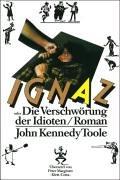
A Confederacy of Dunces
John Kennedy Toole · 1937–1969 · United States
Why it matters
A grandiose, flatulent, medievalist misfit rages through 1960s New Orleans in search of employment he's constitutionally unfit for. Toole killed himself over its rejection; his mother's decade-long campaign got it published, and it won the Pulitzer posthumously.
At a glance
Comic, fast-moving prose despite an eccentric, digressive protagonist.
Deep dive
Why Ignatius Reilly's devotion to Boethius's Wheel of Fortune never actually teaches him anything, and what that refusal says about the entire idea of a comic novel's happy ending.
Written for readers who have finished the book. No plot recap, and nothing here is safe to read first.
Themes & symbolism
Ignatius is a medievalist obsessed with Boethius's Wheel of Fortune, and Toole builds the whole plot as that wheel spinning under him — a hot dog cart, a pants factory, a doomed labor uprising, each catastrophe simply the wheel's next turn rather than punishment or growth. His body, with its pyloric valve clenching shut whenever the modern world offends him, its girth, its constant comic flatulence, is New Orleans's own bloat and indigestion made literal: a city of crumbling grandeur and bad plumbing gets the protagonist its excesses deserve.
The satire cuts in two directions at once — Ignatius's contempt for 'the twentieth century' and his conviction that geometry and theology are its lost correctives is clearly grandiose self-delusion, but the modern world Toole surrounds him with, exploitative factory owners, a predatory strip-club operator, a police force harassing the harmless, rarely disproves him. Every other character runs an equally deluded operation of their own — Myrna Minkoff's crusading progressivism, Patrolman Mancuso's doomed disguises, Mrs. Levy's marriage therapy by exercise board — so Ignatius reads less as a lone eccentric than as the loudest instance of a citywide condition.
A Novel Published by Its Author's Absence
Toole killed himself in 1969 after the manuscript was rejected, convinced the book would never be read; his mother, Thelma, spent over a decade hounding publishers and finally cornered novelist Walker Percy, who read it reluctantly and found he couldn't put it down. Percy's foreword to the 1980 edition makes the book's afterlife part of its meaning — a comic novel that exists at all only because of a mother's stubbornness following her son's despair, which is why its posthumous Pulitzer reads less like vindication than like grief with a medal attached.
Ignatius as Anti-Hero of the Comic Novel
Where a conventional bildungsroman would have Ignatius learn something from his cascading humiliations, Toole withholds growth almost entirely — his protagonist ends the book essentially as insufferable and as certain of his own genius as he began it, which is the novel's most audacious formal choice. Comedy here doesn't resolve into moral instruction; it just generates more comedy, chapter after chapter, until the plot itself has to intervene from outside because Ignatius clearly never will.
The last seal: what actually happens, and why it lands the way it does.
The ending, explained
With his mother finally exhausted enough to have him committed, Myrna Minkoff — his old antagonist and correspondent, dismissed throughout the book as a deluded crusader — arrives unannounced in her car and spirits Ignatius away toward New York before the institution can take him. It's a classic last-minute rescue played entirely for comedy rather than catharsis: Toole gives Ignatius exactly the escape a Fortune's-wheel plot would call for, but pointedly declines to suggest he's earned it or changed. Whether Myrna represents genuine deliverance or just another delusional relationship for Ignatius to inflict himself on is left open, which suits a novel that never once let its hero learn anything — the wheel just turns again, off the page.
Where to go next
 Flannery O'Connor · 1955A Good Man Is Hard to FindLvl 5Fast paced
 Cormac McCarthy · 1992All the Pretty HorsesLvl 6Medium pace
 Carson McCullers · 1940The Heart Is a Lonely HunterLvl 5Medium pace
 Eudora Welty · 1972The Optimist's DaughterLvl 4Medium pace
 DBC Pierre · 2003Vernon God LittleLvl 5Fast paced
 James McBride · 2013The Good Lord BirdLvl 5Fast paced