
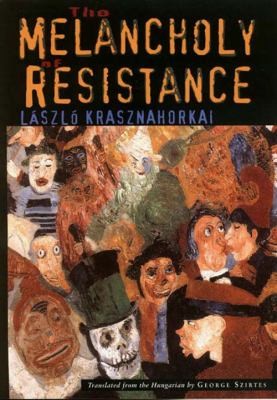
The Melancholy of Resistance
László Krasznahorkai · b. 1954 · Hungary
Originally Az Ellenállás Melankóliája (Hungarian) · translated by George Szirtes
Why it matters
A circus arrives in a Hungarian town hauling a dead whale, and order collapses. Krasznahorkai's great parable of mob, fear, and entropy: Sontag's 'master of the apocalypse' at full force.
At a glance
Extremely long, spiraling sentences and shifting perspectives sustain a mounting sense of dread.
Deep dive
A stuffed whale hauled into a Hungarian town square by a traveling circus gives its residents something to worship or destroy, and the answer turns out to hinge on a piano an obsessive local musician insists on tuning wrong on purpose.
Written for readers who have finished the book. No plot recap, and nothing here is safe to read first.
Themes & symbolism
The whale itself, embalmed, enormous, and permanently mute, is a pure surface: Krasznahorkai never lets it mean anything on its own, which is exactly why the town can pour every ounce of its accumulated dread and superstition into it. Behind the circus that hauls it travels a seldom-glimpsed figure known only as the Prince, who never issues an order the narrative can quote directly, and whose influence over the gathering crowd works entirely through atmosphere and rumor rather than command, a portrait of mob violence that needs no articulated ideology to organize itself, only a vacuum and an object strange enough to fixate on.
Mrs. Eszter, the domineering estranged wife of the reclusive musician György Eszter, treats the resulting chaos as opportunity rather than threat, using the town's fear to install herself at the head of a self-appointed Committee for Tidiness, order restored as a cover for one petty domestic tyrant's seizure of civic power. Valuska, the town's holy-fool postman, is the novel's sole exception: incapable of joining the crowd's dread, he still finds the whale genuinely wondrous, and reenacts the solar system's orbits with the regulars at his local bar out of an uncomplicated, private faith that cosmic order exists somewhere even if the town around him has stopped believing it.
Werckmeister's Tuning as the Whole Novel's Argument
György Eszter's lifelong project, abandoning the piano's standard equal temperament to retune it toward 'pure,' mathematically exact intervals, sounds like a musicological footnote until it's read as the book's thesis in miniature. Andreas Werckmeister's seventeenth-century tuning system was itself a compromise, a set of slightly impure intervals every register can live with rather than a small number of perfect ones no instrument can sustain across its whole range, and Eszter's crusade against it amounts to a crusade against civilization's willingness to settle for a workable fiction instead of an unbearable truth. Béla Tarr's 2000 film adaptation renamed the whole story after this argument, Werckmeister Harmonies, signaling that the tuning experiment, not the whale, is where the book actually locates its meaning.
The last seal: what actually happens, and why it lands the way it does.
The ending, explained
The Prince's followers finally boil over into open riot, storming the town's hospital and beating the patients inside in a spasm of violence with no ideological content behind it at all, cruelty simply discharging itself once a crowd has been primed long enough. Valuska witnesses the massacre firsthand and is left catatonic by what he's seen, his uncomplicated faith in cosmic order shattered by the one kind of chaos it never accounted for. Military authority eventually arrives to disperse the mob and restore a nominal calm that asks no real questions about what just happened, while Mrs. Eszter's opportunistic committee is left standing, better positioned than it was before the whale ever arrived. Krasznahorkai grants no one a clarifying account of what the riot actually meant, only its aftermath.
Where to go next
 László Krasznahorkai · 1985SatantangoLvl 9Slow burn
 Jon Fosse · 2019SeptologyLvl 8Slow burn
 Milan Kundera · 1984The Unbearable Lightness of BeingLvl 5Slow burn
 W. G. Sebald · 1995The Rings of SaturnLvl 7Slow burn
 Franz Kafka · 1915The MetamorphosisLvl 4Medium pace
 Witold Gombrowicz · 1937FerdydurkeLvl 7Fast paced