
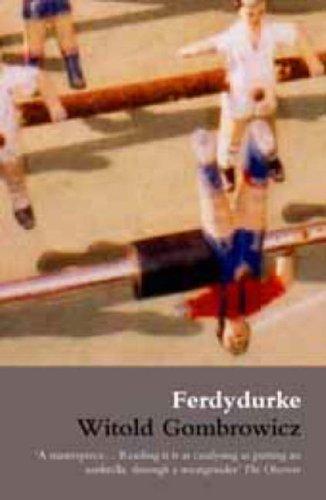
Ferdydurke
Witold Gombrowicz · 1904–1969 · Poland
Originally Ferdydurke (Polish)
Why it matters
A grown man is dragged back into a schoolroom, where the expectations of others reduce him to a boy. Gombrowicz's demented, exuberant farce about immaturity, form, and the impossibility of ever being yourself.
At a glance
Manic, neologism-heavy prose and absurdist logic resist any straightforward reading.
Deep dive
Why a grown man getting dragged back to school is the least strange thing that happens in a novel obsessed with how other people's expectations shrink you into a role.
Written for readers who have finished the book. No plot recap, and nothing here is safe to read first.
Themes & symbolism
Gombrowicz's central idea is "Form" — the notion that no one gets to simply exist as themselves, because every social encounter forces you into a shape dictated by whoever else is in the room, a schoolboy's face put on you by a teacher, an adult's gravity demanded by a dinner party, a lover's posture expected by a woman half your age. Witold's regression into schoolboy status under Pimko isn't a fantastical one-off gag; it's the literal, absurd staging of something the novel insists happens to everyone constantly — the moment you're perceived, you're deformed into whatever "part" the perceiver needs you to play, and there's no adult dignity available that escapes the same trap the classroom makes embarrassingly visible. The novel's escalating episodes — the modernizing bourgeois household straining to prove its progressiveness, the decaying gentry manor performing aristocratic tradition long after it's hollow — are all the same joke restaged at different social altitudes: everyone is a child being watched and shaped by everyone else, and the only variable is how elaborate the costume is.
"Immaturity" in Gombrowicz's hands stops being a deficiency to be outgrown and becomes the permanent, inescapable condition of being a self among other selves — the buttocks, the calf, the mug (his recurring images for the parts of a person that get reduced to caricature by an observer's gaze) are grotesque precisely because they're accurate: this is what a human being looks like once someone else has finished interpreting them. The farce is relentless and deliberately undignified — food fights, a duel fought with grimaces, a seduction plot that curdles into slapstick — because Gombrowicz distrusts nothing more than solemnity, treating high seriousness itself as just another Form people hide behind rather than a route to authenticity.
Exile and the Polish Literary Scene
Gombrowicz published Ferdydurke in Warsaw in 1937 to a mix of bafflement and hostility from a Polish literary establishment devoted to romantic nationalism and interwar seriousness — a culture, in other words, thoroughly organized around exactly the kind of collective Form the novel mocks. He sailed for Argentina weeks before the German invasion in 1939 and ended up stranded there for over two decades, writing in near-total isolation from any Polish readership and supporting himself with bank clerk work, which sharpened rather than softened his contempt for national pieties and literary pretension — his fury at being patronized by expatriate Polish cultural institutions in Buenos Aires shows up directly in his later fiction and diaries. The novel's reputation grew mostly in retrospect and in translation, eventually recognized as one of the twentieth century's great comic-philosophical novels and a direct ancestor to absurdist and theater-of-the-grotesque writing across Europe, but it took Gombrowicz's exile — permanent distance from the very society whose Forms he was anatomizing — to see the book properly appreciated at all.
The last seal: what actually happens, and why it lands the way it does.
The ending, explained
The novel doesn't build to a climax so much as cycle through Form after Form and then simply stop: after the schoolroom, the modern family, and the gentry manor have each demonstrated the same trap in a different costume, Witold flees the manor's collapsing social farce in the company of the servant girl Zuta, out into open countryside. It reads like an escape, but Gombrowicz is careful not to grant it as one — there's no suggestion that the countryside, or Zuta, or flight itself offers an exit from Form, only that this particular episode of being shaped by other people's expectations has ended and another, unnamed one is presumably about to begin. That refusal of closure is the thesis, not a failure to deliver one: Ferdydurke's whole argument is that there's no outside to Form, no authentic self waiting to be liberated once the right escape is found, so ending on an open road rather than a resolved identity is the only ending honest to what the book has been arguing all along.
Where to go next
 Witold Gombrowicz · 1965CosmosLvl 8Medium pace
 Franz Kafka · 1915The MetamorphosisLvl 4Medium pace
 Bohumil Hrabal · 1976Too Loud a SolitudeLvl 6Slow burn
 Bruno Schulz · 1934The Street of CrocodilesLvl 8Slow burn
 Milan Kundera · 1984The Unbearable Lightness of BeingLvl 5Slow burn
 László Krasznahorkai · 1985SatantangoLvl 9Slow burn