
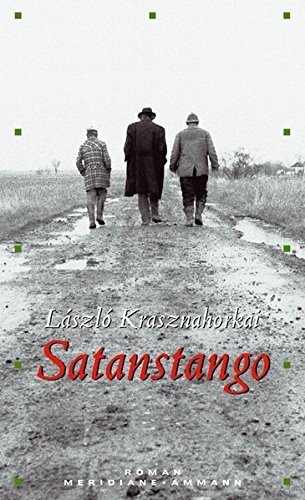
Satantango
László Krasznahorkai · b. 1954 · Hungary
Originally Sátántangó (Hungarian) · translated by George Szirtes
Why it matters
A ruined collective farm, a returning con man mistaken for a messiah, and sentences that spiral like the rain that never stops. The apocalyptic long sentence perfected, and, via Béla Tarr, a seven-hour film legend.
At a glance
Page-length sentences, circular chapter structure, and near-total absence of paragraph breaks.
Deep dive
A self-styled messiah times his return to a dying farm for the exact moment its last residents have nothing left to lose — and the sentence describing it refuses, page after page, to give you a place to breathe.
Written for readers who have finished the book. No plot recap, and nothing here is safe to read first.
Themes & symbolism
The title's tango structure — chapters that step forward and then back, doubling on themselves rather than advancing in a straight line — is enacted at the sentence level too: Krasznahorkai's famously punctuation-light, page-spanning sentences deny the reader the relief of a paragraph break the way the estate denies its residents any relief from the rain, so form and atmosphere become the same suffocating thing. The Doctor's obsessive habit of watching and transcribing his neighbors' lives from his window is a kind of false mastery over that entropy — an attempt to hold chaos at bay through documentation that, by the novel's end, turns out to be indistinguishable from the novel itself. Irimiás's return, greeted as near-messianic salvation by villagers desperate enough to hand over their savings on the strength of a rumor, dramatizes how thoroughly collapse hollows out judgment: hints throughout that he's a police informer or a plain confidence man are visible to the reader well before the villagers choose, or are able, to see them.
Esti's subplot — a neglected child who tortures and kills her own cat before poisoning herself — is the novel's rawest register of what this communal collapse costs the powerless, offering no symbolic comfort or redemptive frame, just cruelty passed down the chain to whoever has the least power to resist it. The rain that never lets up across the book is the closest thing to a unifying symbol: a post-socialist landscape stalled in perpetual, directionless decay, waiting for a meaning or a savior that the narrative has already told us, structurally, cannot arrive in a straight line. Even Irimiás's own rhetoric of collective salvation borrows the discredited language of the system the villagers have just watched fail, which is part of why the reader can clock him as false well before any character does — his promises sound exactly like the ones that ruined the estate in the first place.
The Doctor's Notebook
The novel's closing image — the Doctor boarding up his windows against a world he's given up engaging with directly, then resuming his compulsive habit of writing everything down — folds the whole book back on itself, suggesting that what we've just read might be his compiled account rather than a neutral narration from outside the story. That circularity is the tango completing its final step: a novel that began in decay and false hope ends by revealing its own form as another closed loop, watched over by a man who has chosen recording over acting. Béla Tarr's seven-hour 1994 film adaptation, shot in the same suffocating long takes, has become the book's equally legendary companion piece rather than a mere illustration of it, extending the novel's own logic that duration and repetition, not incident, are where its meaning actually lives.
The last seal: what actually happens, and why it lands the way it does.
The ending, explained
Irimiás leads the villagers away from the ruined estate under promises the novel has spent its length suggesting are hollow, whether he's working for the secret police, running a confidence scheme, or some overlapping mix of both — either way, their desperation and credulity are what he's actually harvesting. The estate is left abandoned and decaying, its residents' hope exposed as manipulation rather than salvation. The Doctor alone stays behind, and his return to obsessive writing closes the novel on the same entropic, rain-soaked note it opened on: nothing has been redeemed, nothing has moved forward, and the only response left standing is to keep a record of the ruin.
Where to go next
 László Krasznahorkai · 1989The Melancholy of ResistanceLvl 9Slow burn
 Jon Fosse · 2019SeptologyLvl 8Slow burn
 Milan Kundera · 1984The Unbearable Lightness of BeingLvl 5Slow burn
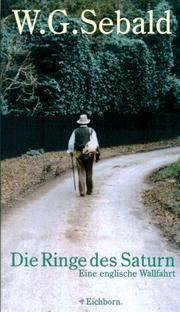 W. G. Sebald · 1995The Rings of SaturnLvl 7Slow burn
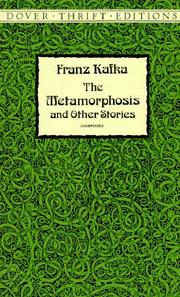 Franz Kafka · 1915The MetamorphosisLvl 4Medium pace
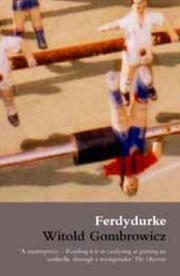 Witold Gombrowicz · 1937FerdydurkeLvl 7Fast paced