
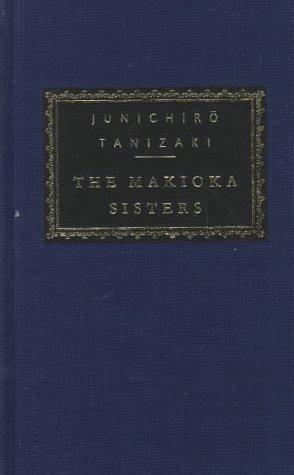
The Makioka Sisters
Jun'ichirō Tanizaki · 1886–1965 · Japan
Originally Sasameyuki (Japanese) · translated by Edward Seidensticker
Why it matters
Four Osaka sisters, a fading merchant house, and the seasonal rituals of a world about to vanish into war. Serialized under wartime censorship and finished after it: the Japanese novel at its most sumptuous and elegiac.
At a glance
Long and detail-dense but told in a plain, unhurried, linear style.
Deep dive
A novel wartime censors tried to silence for being too devoted to kimono fabric and cherry blossoms — and why that devotion is the whole point in retrospect.
Written for readers who have finished the book. No plot recap, and nothing here is safe to read first.
Themes & symbolism
Tanizaki's novel is often praised for its texture — the seasonal cherry-blossom trips to Kyoto, the fabric and kimono detail, the elaborate choreography of the miai process — and it's worth taking that praise literally rather than treating it as mere ornament. The book's entire emotional register depends on the reader loving these rituals as much as the sisters do, because the rituals are what the novel is actually elegizing: a genteel, prosperous, tradition-bound Osaka merchant world that the text itself, confined to its late-1930s setting, never once mentions is about to be obliterated by the war. Tanizaki began serializing the novel during that war and was shut down by censors for exactly this reason — insufficient patriotic urgency, too much bourgeois domestic pleasure at a moment of national sacrifice — and only finished it after Japan's defeat, which means every contemporary reader arrives at the book already knowing what its characters don't: that this is a world being lovingly inventoried in the last years before its disappearance.
The four sisters map a set of live tensions rather than a simple traditional-versus-modern binary. Tsuruko upholds the formal head-of-household status that increasingly looks like empty ceremony; Sachiko, running the real day-to-day life of the family from the branch house, is the novel's true center of gravity; Yukiko's repeated, repeatedly sabotaged arranged marriages turn courtship itself into the book's slow-motion plot engine, each failed miai a small comic tragedy of pride and circumstance; and Taeko's modern, scandal-courting independence gives the family's conservatism something concrete to fail against. None of the four is granted a clean victory — the novel's sympathy is wide enough to hold Yukiko's old-fashioned reticence and Taeko's rebellion as equally legitimate ways of being a woman inside a family running out of road.
Sachiko's centrality is worth dwelling on, since she's neither the eldest nor the most dramatic of the four yet functions as the novel's true vantage point: it's through her practical, endlessly accommodating management of both sisters' crises — Yukiko's marriage prospects, Taeko's scandals — that the reader experiences the slow attrition of the family's authority. She never rebels and never fully capitulates either; she simply absorbs each new complication, which makes her the novel's quiet argument that the family's real strength was never Tsuruko's ceremonial headship but the unglamorous, ongoing labor of holding four very different women together.
Anticlimax as a deliberate formal choice
The novel's famous non-ending — Yukiko's wedding finally happens after years of failed matches, and the last line notes only that her diarrhea persists on the train to the ceremony — is easy to misread as a failure of nerve. It's the opposite: a calculated refusal to give the long-deferred marriage plot the emotional payoff a more conventional saga would have delivered. Tanizaki spends hundreds of pages building toward Yukiko's marriage as the resolution the whole family has been straining for, then declines, at the last possible moment, to let the resolution feel resolved. The body keeps misbehaving; life keeps being mundane and faintly undignified; the ritual proceeds regardless. That's not bathos for its own sake — it's the same argument the novel has been making all along about this vanishing world, that its rituals persist not because they deliver transcendence but because people keep performing them, illness and all, right up until history stops giving them the chance.
Where to go next
 Jun'ichirō Tanizaki · 1925NaomiLvl 4Fast paced
 Jun'ichirō Tanizaki · 1929Some Prefer NettlesLvl 4Slow burn
 Jun'ichirō Tanizaki · 1931QuicksandLvl 5Medium pace
 Jun'ichirō Tanizaki · 1956The KeyLvl 5Medium pace
 Yasunari Kawabata · 1947Snow CountryLvl 5Slow burn
 Yukio Mishima · 1956The Temple of the Golden PavilionLvl 6Slow burn