
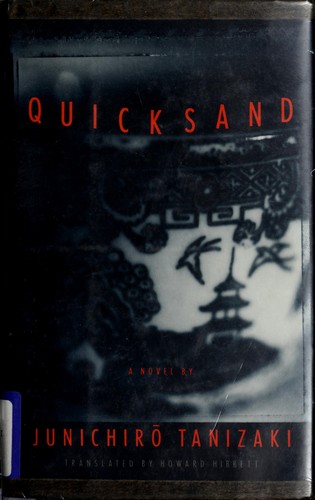
Quicksand
Jun'ichirō Tanizaki · 1886–1965 · Japan
Originally Manji (Japanese) · translated by Howard Hibbett
Why it matters
A bored Osaka housewife's confession to a lawyer spirals through an obsessive affair with a younger woman and the men each draws in after her. Tanizaki's most claustrophobic ménage: devotion curdling into mutual destruction.
At a glance
A single breathless confessional voice narrates an escalating, entangled plot.
Deep dive
Why Sonoko's calm, confiding account of her own worst decisions is far less reliable, about who was actually steering the entangled foursome, than her tone of total control would suggest.
Written for readers who have finished the book. No plot recap, and nothing here is safe to read first.
Themes & symbolism
Manji, the original Japanese title, names the Buddhist swastika, a four-armed symbol Tanizaki uses to describe the shape his plot eventually takes: not a triangle but a whirling foursome, Sonoko, her husband Kotaro, Sonoko's lover Mitsuko, and Mitsuko's on-and-off fiance Watanuki, each pulling the arrangement in a different direction while insisting they're merely responding to someone else's demands. The entire novel is narrated by Sonoko in confession to an unnamed listener, a structure that hands her voice enormous, unearned authority; she frames herself throughout as the reluctant party dragged along by Mitsuko's manipulations, and Tanizaki lets that self-portrait stand just long enough for readers to notice how selectively it's been assembled.
Mitsuko is the novel's true engine, and Tanizaki builds her almost entirely through Sonoko's descriptions, which means readers never get unmediated access to a woman everyone in the book insists is dangerously persuasive. She stages her introduction to Sonoko as an accident, cultivates Watanuki's jealousy as leverage, and eventually turns Kotaro's attraction to her into a weapon against the marriage that gave Sonoko her only stable footing. Whether Mitsuko is genuinely that calculating, or whether Sonoko needs to believe so to excuse her own complicity in every step of the affair's escalation, is a question the confession format is built to leave permanently unsettled. Osaka dialect does its own quiet work throughout: Tanizaki wrote the entire confession in the region's spoken cadences rather than standard Tokyo Japanese, giving Sonoko's voice a gossipy, conversational intimacy that makes her most self-serving claims sound like harmless chatter rather than the careful edits they actually are.
A Confession With No Named Listener
Tanizaki gives Sonoko's account a listener the text never identifies beyond an honorific, addressed directly throughout as 'sensei' but never given a name, a profession beyond the implication of some authority, or a single line of dialogue. That absence puts the reader in an odd position, half interrogator and half confessor, since Sonoko's confiding tone assumes an intimacy the actual reader hasn't earned. It's a structural cousin to The Key, published a quarter-century later, where Tanizaki would again build an entire novel out of a narrator performing candor for an audience whose scrutiny shapes what gets told and what quietly doesn't.
The last seal: what actually happens, and why it lands the way it does.
The ending, explained
With the foursome's arrangement collapsing under its own contradictions and no version of the relationship sustainable for all three surviving parties, Sonoko, Kotaro, and Mitsuko agree to a shared suicide by poisoned sleeping powder, framed between them as the only remaining way to stay bound together. Sonoko takes her dose and loses consciousness expecting to die alongside the other two. She instead wakes up. Kotaro and Mitsuko, it emerges, withheld the actual poison from her portion, leaving her alive while apparently intending to die themselves, or perhaps never intending to die at all, Tanizaki's telling stays coy about which. Sonoko survives to narrate the whole affair, but the confession's real closing note is her dawning, humiliating recognition that even her own death had been something the other two decided for her without asking.
Where to go next
 Jun'ichirō Tanizaki · 1925NaomiLvl 4Fast paced
 Jun'ichirō Tanizaki · 1929Some Prefer NettlesLvl 4Slow burn
 Jun'ichirō Tanizaki · 1948The Makioka SistersLvl 4Slow burn
 Jun'ichirō Tanizaki · 1956The KeyLvl 5Medium pace
 Yasunari Kawabata · 1947Snow CountryLvl 5Slow burn
 Yukio Mishima · 1956The Temple of the Golden PavilionLvl 6Slow burn