
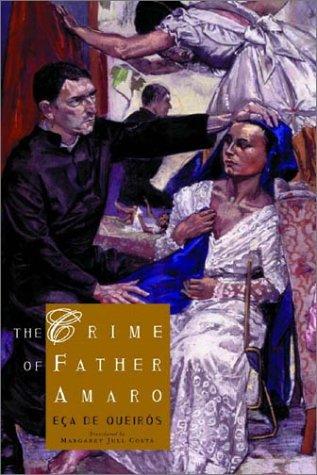
The Crime of Father Amaro
Eça de Queirós · 1845–1900 · Portugal
Originally O Crime do Padre Amaro (Portuguese)
Why it matters
A young priest's affair with his landlady's devout daughter exposes hypocrisy in provincial Portuguese Catholicism. Eça's scandalous debut announced naturalism's arrival in Portuguese letters.
At a glance
Naturalist detail and irony layered across a long provincial plot.
Deep dive
Why a young priest's confessional technique and his seduction technique turn out, in Eça's telling, to be exactly the same set of skills.
Written for readers who have finished the book. No plot recap, and nothing here is safe to read first.
Themes & symbolism
Amaro Vieira arrives in the provincial town of Leiria as a newly ordained priest still barely out of adolescence, and Eça de Queirós builds the novel's central indictment around a specific structural cruelty of enforced clerical celibacy: a young man with entirely ordinary appetites is handed enormous private access and moral authority over women's inner lives through the confessional, then told his own desire simply does not exist, and the gap between that official fiction and his actual body is where the whole plot lives. Amaro's seduction of Amélia, his landlady's devout daughter, is staged less as scandal than as an almost clinical demonstration that confession and courtship use the identical vocabulary, intimacy, secrecy, absolute trust extracted under a claim of spiritual authority, so that Eça can show a priest seducing a parishioner without needing him to say anything a confessor wouldn't ordinarily say.
The town's other clergy give the novel its wider target: Canon Dias keeps a mistress everyone in Leiria politely pretends not to notice, and São Joaneira, Amélia's own mother, has for years quietly accommodated the canon's arrangement in her own household, which means the respectable social fabric of the entire town is already organized around an open secret long before Amaro arrives to add one more. Eça, sharpening the naturalist method he had studied directly from Zola, refuses his readers a single corrupt individual to blame, insisting instead that an entire provincial Catholic culture has built comfortable, unspoken accommodations for exactly the hypocrisy it claims, loudly, to forbid.
Amélia's own religious devotion, genuine and deeply felt rather than merely performed, makes her seduction land as a particular kind of betrayal Eça keeps sharpening throughout the book: the same faith that was supposed to protect her virtue is the precise instrument used to dismantle it, since Amaro's authority over her comes entirely from the church she trusts completely, and her guilt afterward is processed almost entirely through that same religious framework rather than through any secular understanding of what has actually been done to her.
A Novel Portugal Tried to Suppress Twice
Eça published two substantially different versions of the novel, revising it after its first serialized appearance provoked outrage from Portuguese clergy and conservative critics who accused him of slandering the priesthood wholesale; rather than soften the anticlericalism, his revisions mostly sharpened the social satire and deepened Amélia's own interiority, a rare case of a scandalized reception producing a harder book rather than a gentler one. The controversy cemented Eça as Portugal's most confrontational realist, doing for Portuguese Catholic provincial life roughly what Zola was doing for French industrial and bourgeois life in the same decade.
The last seal: what actually happens, and why it lands the way it does.
The ending, explained
Amélia's pregnancy, discovered too late to conceal from Leiria's watchful gossip, forces Amaro and the town's clerical network into arranging a secret, dangerous birth attended by a local midwife known for making inconvenient infants disappear, and the child dies in her care under circumstances the novel leaves just short of an explicit confession of infanticide. Amélia herself dies shortly after from complications of the birth, and Amaro, protected at every turn by the same institutional solidarity that let his seduction of her go unquestioned in the first place, faces no real consequence at all, quietly securing a more prestigious clerical post years later. Eça closes on Amaro encountering Amélia's illegitimate half-sister as a grown woman without a flicker of recognition or guilt, the novel's final, coldest joke being that the church's capacity to absorb and forget its own crimes turns out to be limitless.
Where to go next
 Eça de Queirós · 1888The MaiasLvl 6Medium pace
 Émile Zola · 1885GerminalLvl 5Medium pace
 Stephen Crane · 1895The Red Badge of CourageLvl 5Fast paced
 Theodore Dreiser · 1900Sister CarrieLvl 4Medium pace
 Władysław Reymont · 1904The PeasantsLvl 5Slow burn
 Giovanni Verga · 1881The House by the Medlar TreeLvl 6Slow burn