
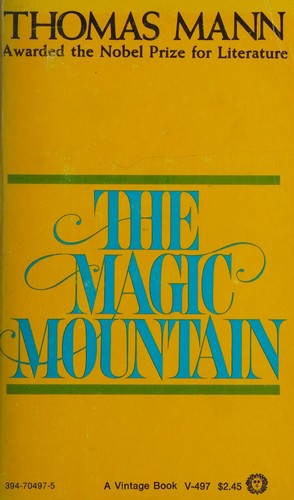
The Magic Mountain
Thomas Mann · 1875–1955 · Germany
Originally Der Zauberberg (German)
Why it matters
Seven years in an Alpine sanatorium where Europe's ideas (reason, romanticism, radicalism) argue over a young engineer's soul until the guns of 1914 end the seminar. The novel of ideas at its grandest.
At a glance
Long philosophical dialogues and essayistic digressions dominate over plot.
Deep dive
Naphta and Settembrini argue for seven years so that 1914 can end the argument for them — the duel is only a rehearsal for what the guns finish.
Written for readers who have finished the book. No plot recap, and nothing here is safe to read first.
Themes & symbolism
Naphta and Settembrini are not people in any ordinary novelistic sense; they are positions, argued out to their logical ends, competing for a soul that Mann keeps deliberately unremarkable so that the ideas, not the psychology, can carry the book. Settembrini's Enlightenment humanism — reason, progress, political liberty, the dignity of work and civic life — and Naphta's totalizing counter-argument, which draws on both religious absolutism and revolutionary terror to insist that freedom, reason, and bourgeois order are all a lie worth destroying, are meant to sound, between them, like the entire ideological range Europe was about to fight a war over. Hans's seven years of passive, half-attentive listening amount to the education of a continent compressed into one unremarkable engineer.
Then Mann undercuts both mentors with Mynheer Peeperkorn, whose broken, half-finished sentences and sheer physical, appetite-driven presence humiliate two men who have spent years winning arguments with words. Peeperkorn commands the room by force of simply being alive in it, and neither Naphta's nihilism nor Settembrini's rationalism has any answer for that — which is the novel's real verdict on ideology as such: it can organize a debate but it cannot compete with vitality, and it is vitality, not any argument, that finally makes Hans doubt everything his two mentors have taught him. The Clavdia Chauchat affair belongs to the same logic: one wordless night, permitted only because the sanatorium has already dissolved ordinary time and ordinary morality, does more to educate Hans than any of Naphta and Settembrini's set-piece debates.
The novel's closest thing to a synthesis arrives not from either mentor but from Hans himself, lost and nearly freezing in a snowstorm, where he dreams a vision of a sunlit, humane world hiding a hidden horror at its center and wakes with the thought that for the sake of goodness and love, a person should not let death hold dominion over his thinking. It is the one idea in the book that actually reconciles Settembrini's humanism with the reality of suffering Naphta insists reason can't touch — and Mann pointedly has Hans forget it almost immediately, back in the ordinary air of the sanatorium, which is exactly the point: the mountain produces real insight and then swallows it, and only the war outside will make anything stick.
Narrated Time Mimics Lived Time
Mann builds the novel's form around the same distortion of time that afflicts his characters: the opening chapters spend enormous, granular attention on single days, replicating how vividly slow and endless time feels to a healthy visitor in his first weeks, while later chapters casually compress months and years into a page or two, replicating how time collapses once illness, leisure, and repetition have dissolved a person's sense of duration. By the time war arrives, seven years have passed almost without Hans's, or the reader's, noticing — the sanatorium's suspended, undifferentiated time turns out to have been the novel's argument all along, made formally rather than stated outright.
The last seal: what actually happens, and why it lands the way it does.
The ending, explained
The outbreak of the First World War in 1914 does what none of the mountain's arguments could: it ends the seminar by force. Hans Castorp, permanently altered by seven years of intellectual, erotic, and near-mystical education but with none of the ideological questions actually resolved, descends from the Berghof and is swept into the war as an anonymous soldier. Mann deliberately withholds Hans's fate on the battlefield — he is last glimpsed amid mud and chaos, his survival unconfirmed — because confirming it would shrink a civilizational catastrophe back down into an individual story. The narrator steps outside the narrative to address the reader directly, calling the mountain's suspended time a "great stupor" that the war has simply, brutally ended, making the point that no debate, however grand, was ever going to settle what artillery settled instead.
Where to go next
 Thomas Mann · 1901BuddenbrooksLvl 5Slow burn
 Thomas Mann · 1912Death in VeniceLvl 6Slow burn
 Thomas Mann · 1933Joseph and His BrothersLvl 8Slow burn
 Thomas Mann · 1947Doctor FaustusLvl 8Slow burn
 Thomas Mann · 1954Confessions of Felix Krull, Confidence ManLvl 5Medium pace
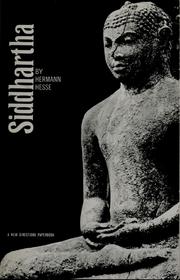 Hermann Hesse · 1922SiddharthaLvl 3Medium pace