
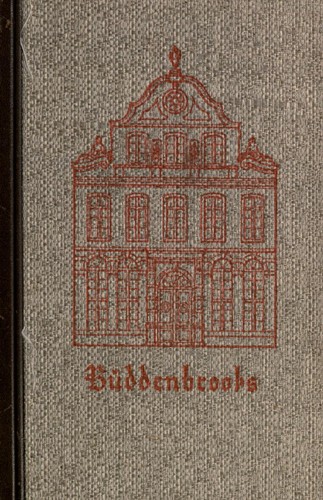
Buddenbrooks
Thomas Mann · 1875–1955 · Germany
Originally Buddenbrooks (German)
Why it matters
Four generations of a Lübeck merchant family in patient decline, written at twenty-five and cited by the Nobel committee decades later. The bourgeois novel perfected at the very moment its world began to end.
At a glance
Long, detailed multi-generational chronicle in relatively accessible prose.
Deep dive
Why each Buddenbrook generation gets more sensitive and less fit to run the family firm, and what that has to do with Schopenhauer.
Written for readers who have finished the book. No plot recap, and nothing here is safe to read first.
Themes & symbolism
Mann structures four generations of a Lübeck grain-trading family as a slow physiological argument: each generation that inherits the family firm is more refined, more self-aware, and measurably less equipped to survive in the world that built its fortune. Old Johann Buddenbrook is robust and unreflective; his son Jean is pious and dutiful but already anxious; his grandson Thomas holds the firm together through sheer willed discipline, aware the whole time that discipline is a performance; and Thomas's son Hanno, sensitive, musical, physically frail from birth, cannot survive contact with the family trade at all. Mann subtitled the book "Verfall einer Familie," the decline of a family, and means decline almost clinically: vitality draining out with each birth.
Thomas's mid-life encounter with a chapter of Schopenhauer, read almost by accident one evening, gives the novel its philosophical hinge: for one night, the idea that individual identity is illusion and death is a return to an undifferentiated will genuinely consoles a man who has spent his life performing a role he no longer believes in. Mann then has Thomas wake the next morning embarrassed by his own conversion and go back to running the firm exactly as before, which is the novel's real judgment on both bourgeois duty and philosophical comfort: neither one actually holds.
Hanno's gift for music, especially his prolonged, harmonically wandering piano improvisations that scandalize the family's more conventional taste, becomes the clearest sign of where the Buddenbrook line has been heading all along, away from commerce and toward an aestheticism that has no practical use and, in Mann's telling, no will to live attached to it either.
Lübeck Recognized Itself, and Never Quite Forgave Him
Mann drew the Buddenbrooks directly from his own family, merchants and senators in Lübeck for generations, and the city's residents read the novel on publication as a roman à clef, matching real neighbors to Mann's fictional characters with enough confidence that Mann's standing at home stayed strained for years. When the Swedish Academy awarded him the Nobel Prize in 1929, the citation named Buddenbrooks specifically as the achievement, a novel published when Mann was only twenty-five and drawing, with a young man's total confidence, on a decline he had grown up inside of rather than researched from outside it.
The last seal: what actually happens, and why it lands the way it does.
The ending, explained
Hanno's decline resolves the family's fate rather than delaying it: undersized and unable to bear the pressure his father hoped commerce would instill, he succumbs to typhoid as a teenager, and with him the Buddenbrook name effectively runs out, since Thomas has no other heir. Mann closes not on Thomas, who has already collapsed years earlier in a scene as undignified as his life had been controlled, but on the surviving women: Tony Buddenbrook, twice-divorced and reduced in circumstance, gathered with her sister-in-law Gerda and old family friends, still narrating the family's misfortunes with the same brisk insistence on appearances that opened the book. The firm is gone, the house is sold, and the talk continues exactly as if nothing underneath it had actually changed.
Where to go next
 Thomas Mann · 1912Death in VeniceLvl 6Slow burn
 Thomas Mann · 1924The Magic MountainLvl 8Slow burn
 Thomas Mann · 1933Joseph and His BrothersLvl 8Slow burn
 Thomas Mann · 1947Doctor FaustusLvl 8Slow burn
 Thomas Mann · 1954Confessions of Felix Krull, Confidence ManLvl 5Medium pace
 Hermann Hesse · 1922SiddharthaLvl 3Medium pace