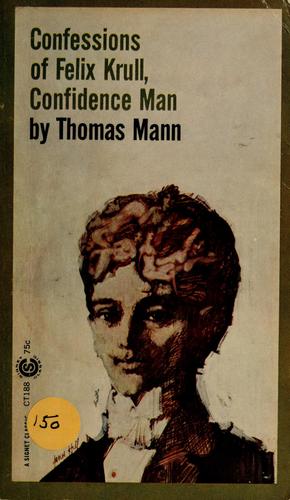
Confessions of Felix Krull, Confidence Man
Thomas Mann · 1875–1955 · Germany
Originally Bekenntnisse des Hochstaplers Felix Krull (German)
Why it matters
An irresistible con man charms his way up through European society, Mann's late, unfinished return to comedy after a career spent on decline and damnation. The picaresque rogue as a wink at his own younger, hungrier self.
At a glance
Playful, ornate voice, but the con artist's episodic exploits read easily.
Deep dive
A charming con man narrates his own criminal education as though it were a Goethe-style memoir of self-cultivation, and Mann never lived to finish deciding how far the joke would go.
Written for readers who have finished the book. No plot recap, and nothing here is safe to read first.
Themes & symbolism
Felix Krull's gift is total: he can forge a signature, a title, an accent, or a whole biography with equal fluency, and Mann treats this criminal talent as the logical extreme of the artist figure he'd been writing in disguise since Tonio Kroger, the confidence man and the novelist both in the business of constructing a persuasive self out of nothing but observed gesture and borrowed material. Where Mann's earlier artist heroes suffer for their alienation from respectable bourgeois life, Krull suffers nothing, he simply enjoys being extraordinary at fraud, and the absence of guilt is the book's most pointed argument, that art and confidence trickery share a method Mann had spent decades treating far more solemnly.
The novel's elevated, faintly pompous prose style, Krull narrating petty theft and seduction in the cadences of a statesman's memoir, is a direct parody of Goethe's autobiography Dichtung und Wahrheit and of the confession as a literary form generally, genres that assume the person confessing has something true and improving to report. Mann lets Krull borrow every formal convention of that solemn tradition, the retrospective wisdom, the moral self-accounting, and empties it of any actual remorse, so the gap between Krull's grand style and his small crimes becomes the joke sustaining the entire book.
A Fragment Mann Carried for Four Decades
Mann first wrote a Felix Krull fragment in 1911, set it aside for other work, and returned to expand it into a full novel only at the very end of his life, publishing it in 1954, a year before his death in 1955. The book's incompleteness is therefore not an accident of a life cut short mid-project so much as the closing act of a writer who had spent his whole career circling the con man as a shadow version of the artist, finally letting that shadow figure have the last, unfinished word.
Lisbon, the Kuckucks, and the Break in the Manuscript
Traveling under a stolen identity as the Marquis de Venosta, Krull reaches Lisbon and is drawn into the household of Professor Kuckuck, a paleontologist who lectures Krull at length on the deep time of the earth's formation, and into the orbit of Kuckuck's daughter Zouzou and, in the manuscript's final pages, her mother. The text breaks off mid-seduction, with no resolution offered, and critics have long debated whether Mann simply ran out of life before he could finish or whether an ending was always beside the point for a confidence man whose whole nature depends on never being caught and never settling into a fixed, accountable self.