
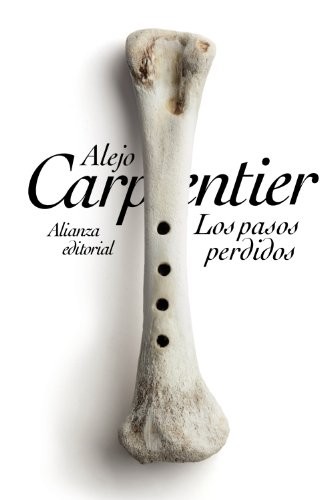
The Lost Steps
Alejo Carpentier · 1904–1980 · Cuba
Originally Los pasos perdidos (Spanish) · translated by Harriet de Onís
Why it matters
A disillusioned composer travels up a South American river in search of primitive musical instruments, and finds time itself running backward. Carpentier's other landmark of lo real maravilloso, structured as a journey out of modernity.
At a glance
Dense, allusive prose structures a journey backward through historical and mythic time.
Deep dive
A composer flees New York for what he believes is civilization's origin point up an unmapped South American river, and finds a form of time he can't actually stay inside.
Written for readers who have finished the book. No plot recap, and nothing here is safe to read first.
Themes & symbolism
Carpentier's unnamed narrator, a New York-based composer numbed by advertising jingles and a failing marriage, accepts a museum commission to retrieve primitive musical instruments from deep in the South American interior, and the journey he undertakes up the Orinoco becomes, in Carpentier's telling, a passage backward through historical time itself: colonial towns give way to frontier settlements, then to a village still organized by feudal hierarchy, then finally to a community that has, in the narrator's eyes, barely emerged from the Neolithic. This isn't travel writing dressed up as fiction, Carpentier is staging his own theory of lo real maravilloso, the marvelous real, the idea that Latin America's landscape and history contain, without any narrative embellishment required, a simultaneity of historical eras that European surrealism had to invent artificially.
Rosario, the mestiza woman the narrator falls for during the journey, and the utopian jungle settlement of Santa Mónica de los Venados where he briefly settles, represent his fantasy of a life outside modernity's exhausted forms, a place where he can finally compose music that matters rather than jingles that don't. Carpentier is careful to make this fantasy genuinely seductive rather than a strawman: the narrator's happiness at Santa Mónica is real, his sense of creative and erotic renewal is real, which is exactly what makes his eventual failure to remain there so damning, not of the jungle's authenticity, but of his own capacity to belong to anything that doesn't eventually demand paper, permanence, and a return address.
The Manuscript Problem: Why Going Back Doesn't Work
When the narrator returns to New York to formally end his old life and gather materials before rejoining Rosario for good, he discovers that the river's mouth, and the specific tributary leading back to Santa Mónica, has flooded and become impossible to relocate: no map, no local guide, no act of will can retrace the route a second time. Carpentier is explicit that this isn't a technical failure of navigation. The narrator's own bad faith, his need to formalize an escape that only worked because it was never planned as one, is what actually closes the path, civilization's paperwork follows him back into the jungle and makes the jungle refuse to be entered on those terms again.
The last seal: what actually happens, and why it lands the way it does.
The ending, explained
Unable to relocate Santa Mónica or Rosario, the narrator is left permanently exiled from the world he briefly inhabited, back in New York with the instruments he was sent to collect and none of the transformation he actually wanted, and Carpentier ends the novel on that irreversible loss rather than any reconciliation. The lost steps of the title are literal by the final pages, an actual path back that no longer exists, but they're also Carpentier's harder claim: that modern man, once he's internalized clock time, contracts, and the habit of formalizing his own decisions, may no longer be capable of the kind of unplanned belonging Santa Mónica offered, even when he wants it more than anything else in his life.
Where to go next
 Alejo Carpentier · 1949The Kingdom of This WorldLvl 5Medium pace
 Elena Garro · 1963Recollections of Things to ComeLvl 7Slow burn
 Gabriel García Márquez · 1967One Hundred Years of SolitudeLvl 6Medium pace
 Miguel Ángel Asturias · 1946El Señor PresidenteLvl 8Slow burn
 Juan Rulfo · 1955Pedro PáramoLvl 7Slow burn
 Mariano Azuela · 1915The UnderdogsLvl 4Fast paced