
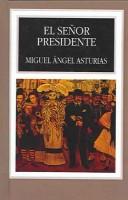
El Señor Presidente
Miguel Ángel Asturias · 1899–1974 · Guatemala
Originally El Señor Presidente (Spanish)
Why it matters
An unnamed dictator's reign of terror is conjured through nightmarish, hallucinatory prose that blurs myth and atrocity. Latin America's first great dictator novel, and a direct ancestor of magical realism's political uses.
At a glance
Hallucinatory, poetic prose obscures cause and effect to convey terror directly.
Deep dive
How Asturias turns the daily mechanics of a dictatorship — surveillance, rumor, forced confession — into a prose style as disorienting as living under one.
Written for readers who have finished the book. No plot recap, and nothing here is safe to read first.
Themes & symbolism
Asturias never names his dictator or his country, and that anonymity is the novel's first political argument: this isn't a roman à clef about one Central American strongman (though the model, Guatemala's real Manuel Estrada Cabrera, is unmistakable underneath), it's a portrait of the machinery of absolute power in the abstract, transferable to any regime that runs on the same fuel of fear, informers, and manufactured guilt. The prose itself enacts the terror rather than just describing it — chapters open in dreamlike, hallucinatory registers borrowed from indigenous myth and oral storytelling, blurring waking life and nightmare so thoroughly that the reader experiences something like the same epistemic vertigo as the characters, never sure which rumor is true, which arrest is really happening, which confession was extracted rather than given.
The novel's engine is the way the regime manufactures its own pretexts: a colonel's death, actually orchestrated by the President's own men using a scapegoat known as the Zany (a mute beggar tormented into a fatal breakdown), is retroactively pinned on General Canales purely because the President has decided Canales is inconvenient. Cara de Ángel, the President's most trusted and physically striking aide, embodies the novel's bleakest thesis: proximity to power offers no protection, only a longer runway before the same machine turns on you, because a system built on loyalty enforced through terror cannot actually distinguish loyal service from expendable liability once it needs a sacrifice.
Estrada Cabrera and the Birth of the Dictator Novel
Asturias began drafting the novel in the 1920s while in political exile in Paris, drawing directly on the twenty-two-year rule of Guatemala's Manuel Estrada Cabrera, a regime built on an actual secret police apparatus, staged public adulation, and the casual disappearance of anyone who fell out of favor; Asturias himself had grown up watching the personality cult and terror operate at close range before it collapsed in 1920. Published in 1946, El Señor Presidente is generally credited as the founding text of the Latin American 'dictator novel,' a genre that would eventually include Roa Bastos's I the Supreme, García Márquez's Autumn of the Patriarch, and Vargas Llosa's own The Feast of the Goat — all of them descended, directly or not, from Asturias's insight that the only adequate form for portraying absolute power is a prose style willing to abandon realist stability altogether.
A Nobel Built on Myth and Politics at Once
Asturias won the Nobel Prize in Literature in 1967, cited for work rooted in Guatemalan and broader Mayan indigenous tradition as much as for his political fiction, and El Señor Presidente sits at exactly that intersection: its nightmare logic and mythic cadences draw as heavily on Mayan oral narrative and the Popol Vuh's cosmology as its plot draws on twentieth-century Guatemalan history. That fusion — pre-Columbian mythic texture used to render very modern state terror — is usually credited as a direct forerunner of the 'magical realism' label that would later attach to García Márquez and the Boom, except that Asturias's magic is rarely wonder for its own sake; it's almost always in service of making authoritarian violence feel as disorienting on the page as it did to live through.
The last seal: what actually happens, and why it lands the way it does.
The ending, explained
Cara de Ángel, having helped General Canales escape the regime's manufactured case against him and having fallen in love with and married Canales's daughter Camila, becomes the President's next target purely on suspicion of divided loyalty — proof enough in a system where the appearance of doubt is itself the crime. He is arrested on invented pretenses and held in solitary confinement, where his jailers, under orders, feed him the calculated lie that Camila has left him and become the President's mistress. Cara de Ángel has no way to verify or disprove this from his cell, and the isolation does exactly what it's designed to do: he dies in prison believing the lie, in total psychological collapse, without ever learning that Camila in fact remained faithful to him. The novel closes with the regime completely unshaken — the President's power intact, the truth of what happened to his most loyal aide never surfacing, life in the capital resuming its outward normalcy under the same terror as before. Asturias denies the reader any downfall or reckoning on purpose: the point of the dictator novel, inaugurated here, is that these systems don't get defeated by the plot of a single book: they persist by consuming even the people who serve them best, and the machine simply resets.
Where to go next
 Miguel Ángel Asturias · 1949Men of MaizeLvl 9Slow burn
 Augusto Roa Bastos · 1974I, the SupremeLvl 9Slow burn
 Gabriel García Márquez · 1967One Hundred Years of SolitudeLvl 6Medium pace
 Elena Garro · 1963Recollections of Things to ComeLvl 7Slow burn
 Alejo Carpentier · 1949The Kingdom of This WorldLvl 5Medium pace
 Juan Rulfo · 1955Pedro PáramoLvl 7Slow burn