
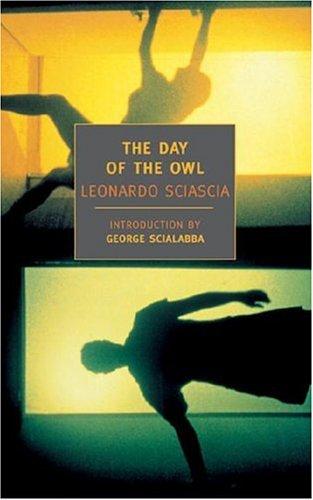
The Day of the Owl
Leonardo Sciascia · 1921–1989 · Italy
Originally Il giorno della civetta (Italian)
Why it matters
An honest carabiniere investigates a small-town murder and finds the trail leading straight into Mafia collusion reaching Rome itself. One of the first novels to name the Mafia's grip on Italian institutions directly.
At a glance
Terse, dialogue-forward procedural prose, deliberately unshowy.
Deep dive
How far up the chain a small-town bus-stop shooting investigation actually reaches once the honest captain stops asking polite questions, and why that reach is the whole point of the book.
Written for readers who have finished the book. No plot recap, and nothing here is safe to read first.
Themes & symbolism
Sciascia builds his plot like a conventional police procedural, a contractor gunned down boarding a bus in broad daylight, precisely so he can dismantle the genre's usual comfort: in most detective fiction, solving the crime restores order. Here, Captain Bellodi's investigation functions instead as a diagnostic instrument, and what it diagnoses is that the local silence around the killing, omertà treated by outsiders as folklore, is in fact a rational, self-protecting response to a power structure that punishes anyone who breaks it. Witnesses who saw everything develop, overnight, a documented inability to have seen anything at all, and Sciascia never treats that reflex as cowardice so much as an entirely sound reading of the odds.
Bellodi, a northerner and a former partisan, keeps colliding with the local conviction that men divide into two categories, uomini, real men who can be reasoned with or feared, and the rest, who don't count. Don Mariano Arena, the mafia boss whose polite conversations with Bellodi carry more real information than any interrogation, uses that same taxonomy to explain, almost affectionately, why Bellodi's honesty will never actually change anything: he respects the captain as a uomo precisely because he expects him to lose. Their scenes together are the novel's real engine, two men who understand each other completely and are working toward entirely incompatible outcomes.
A Genre Novel That Named an Institution Nobody Named in Print
Published in 1961, when Italian officials still routinely described the Mafia as regional folklore or outright denied its existence as an organization, Sciascia's decision to trace a single murder straight through local omertà into a parliamentary deputy's office was a genuinely dangerous act of naming, not just a literary device. The novel's own Sicilian publisher declined to sell it locally at first for fear of reprisals, and Sciascia spent the rest of his long career as the Italian writer most associated with saying plainly, in fiction, what the country's own institutions still would not say in fact. Later Italian crime writing about organized power owes this short book a specific, traceable debt: the template of the incorruptible outsider investigator meeting a wall of complicity that reaches all the way to Rome itself starts here.
The last seal: what actually happens, and why it lands the way it does.
The ending, explained
The evidence chain Bellodi has painstakingly built reaches all the way to a sitting deputy in Rome, and the novel's last movement shows exactly how that reach gets neutralized: witnesses recant, an alibi is manufactured for Don Mariano, and Bellodi himself is quietly transferred off the case and out of Sicily entirely, the department's real answer to an investigation that got too close. Sciascia closes not on defeat exactly but on Bellodi's private vow, made from the mainland, to come back to Sicily even if it takes him the rest of his career, a promise the novel gives no reason to think the system will ever let him keep.
Where to go next
 Leonardo Sciascia · 1966To Each His OwnLvl 4Fast paced
 Luigi Pirandello · 1904The Late Mattia PascalLvl 5Medium pace
 Antonio Tabucchi · 1994Pereira MaintainsLvl 4Medium pace
 Natalia Ginzburg · 1963Family LexiconLvl 4Medium pace
 Alberto Moravia · 1951The ConformistLvl 5Medium pace
 Pete Dexter · 1988Paris TroutLvl 4Fast paced