
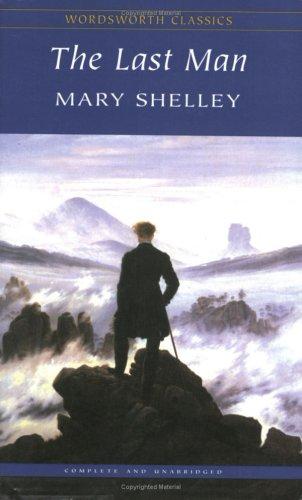
The Last Man
Mary Shelley · 1797–1851 · England
Why it matters
A plague sweeps across a late-twenty-first-century world, leaving one man to narrate humanity's extinction. An early and startlingly bleak work of apocalyptic fiction from Frankenstein's author.
At a glance
Ornate, formal early-19th-century prose stretched across a sprawling apocalyptic plot.
Deep dive
A plague empties out the last decades of the twenty-first century, and Mary Shelley wrote the emptying just after burying most of the people she loved.
Written for readers who have finished the book. No plot recap, and nothing here is safe to read first.
Themes & symbolism
Lionel Verney survives into a depopulated England as the sole witness to a species-wide extinction, and Shelley refuses the plague any of the moralizing logic older plague fiction relies on: it does not punish vice or spare virtue, it simply removes people, famous and obscure, faithful and treacherous, at the same indifferent rate. The novel's frame, a set of Sibylline leaves found scattered in a Neapolitan cave and pieced together by an unnamed editor, keeps even Verney's own testimony at one remove, as if the extinction of humanity were too large an event for any single voice to report without mediation.
Adrian, Earl of Windsor, and Lord Raymond are close enough to Percy Shelley and Byron that the novel reads as elegy wearing the costume of prophecy: Adrian renounces the English throne to live as a private idealist devoted to poetry and reform before drowning at sea, Raymond abandons a domestic life for military glory and dies laying siege to Constantinople. Shelley wrote this after both men were actually dead, Percy drowned off the Italian coast in 1822, Byron gone in Greece in 1824, so the novel isn't guessing at their ends so much as replaying them inside a fiction large enough to hold her grief.
England's brief experiment as a republic, engineered by Adrian's own family surrendering the crown, collapses not because the political idea fails but because the plague renders every institution equally irrelevant, a bleak answer to the perfectibility arguments Shelley grew up inside courtesy of her father William Godwin and her husband alike. Reform, republic, and utopian planning all turn out to be questions the world stops asking once there's no population left to govern.
A Circle of the Dead, Fictionalized While Still Warm
By the time Shelley finished the manuscript in 1826, she had lost her husband, Byron, and two of her three children, and the novel's occasional real-name winks (a cameo appearance from a poet clearly meant as Shelley herself) sit inside otherwise heavily disguised portraiture. Contemporary reviewers, expecting another Frankenstein, found the book's total bleakness, no monster to defeat, no survivors to celebrate, simply depressing rather than thrilling, and it went out of print for decades before twentieth-century critics recovered it as one of English fiction's first sustained apocalypses.
The last seal: what actually happens, and why it lands the way it does.
The ending, explained
Verney reaches Rome to find it entirely empty, the last other survivor he'd been traveling with having died along the way, and Shelley declines to grant him even the comfort of despair resolving into anything final. He gathers books, provisions, and a surviving dog, and sets out by boat to sail the coastlines of an empty world on the chance that somewhere another human being is still alive, a search the novel ends without concluding. There's no rescue, no revelation, and no death scene either, just a single man's account trailing off into an open, unanswered voyage, which is Shelley's way of refusing the genre's later habit of tidy last-man-standing catharsis before the genre had even fully formed.
Where to go next
 Mary Shelley · 1818FrankensteinLvl 4Medium pace
 Johann Wolfgang von Goethe · 1774The Sorrows of Young WertherLvl 3Medium pace
 Heinrich von Kleist · 1810Michael KohlhaasLvl 6Fast paced
 Walter Scott · 1814WaverleyLvl 6Medium pace
 Emily Brontë · 1847Wuthering HeightsLvl 6Medium pace
 Honoré de Balzac · 1835Père GoriotLvl 4Medium pace