
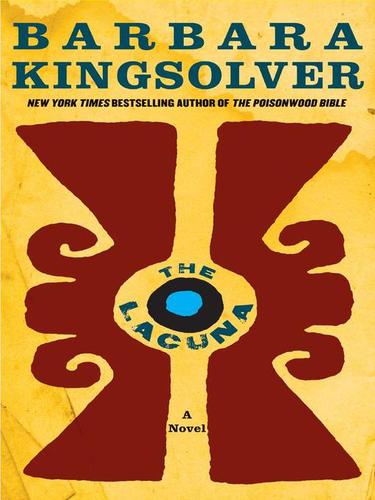
The Lacuna
Barbara Kingsolver · b. 1955 · USA
Why it matters
Harrison Shepherd, American-born but raised in 1930s Mexico, mixes plaster for Diego Rivera and Frida Kahlo, serves as Trotsky's secretary in exile, then becomes a suspected novelist during the McCarthy era back in the US. An epic, document-laced sweep through revolutionary Mexico and Red Scare America.
At a glance
A long historical sweep assembled from diary entries and inserted documents asks for sustained attention.
Deep dive
A boy who grows up mixing plaster for Diego Rivera and cooking for Frida Kahlo ends up, decades later, hunted by his own government for a friendship with a man whose assassination by ice axe is already public record, and Barbara Kingsolver builds the whole novel out of what Harrison Shepherd chooses to leave out of his own archive.
Written for readers who have finished the book. No plot recap, and nothing here is safe to read first.
Themes & symbolism
Harrison Shepherd, born to an American father and Mexican mother, grows up between countries and languages before landing, as a teenager, in the household of Diego Rivera and Frida Kahlo, mixing plaster for Rivera's murals and absorbing Kahlo's unsparing wit at close range. Kingsolver builds the early chapters around Shepherd's job as a kind of privileged invisibility, present for everything, indispensable to no one's story but his own, that later becomes his defining skill: when Kahlo brings the exiled Leon Trotsky into the household, Shepherd becomes his secretary and, on the day of Trotsky's assassination in 1940, one of the few witnesses to the murder itself.
The novel's second half relocates Shepherd to North Carolina, where he reinvents himself as a bestselling novelist writing historical fiction about ancient Mexico, only to have his own history catch up with him: his old proximity to Trotsky and Rivera makes him a target during the McCarthy-era hearings, and Kingsolver stages the House Un-American Activities Committee's treatment of Shepherd's actual novels, read aloud, misquoted, and reinterpreted as coded communist propaganda, as a portrait of how thoroughly a public figure's own words can be seized and rewritten by people who never bothered to actually read them.
The novel's framing device, Shepherd's notebooks and letters, gathered and annotated after his death by his loyal stenographer Violet Brown, makes the archive itself a character: Violet's occasional interjections, correcting a date, defending Shepherd's memory against the press coverage that hounded him, turn The Lacuna into a novel explicitly about the unreliability and the necessity of the historical record, the lacuna of the title being both the underwater cave of Shepherd's Mexican childhood and every gap the record leaves for other people to fill in with their own agendas.
Trotsky's Household as a Study in Proximity to History
Kingsolver renders Trotsky not as a distant historical icon but as an anxious, aging man doing crossword puzzles and tending rabbits while awaiting an assassin he knows is coming, and Shepherd's closeness to that mundane domestic reality, rather than to Trotsky's political theory, is what the McCarthy hearings later prove incapable of understanding: guilt by association assumes ideological intimacy where the novel has shown the reader only shared meals and shared grief.
The last seal: what actually happens, and why it lands the way it does.
The ending, explained
Exhausted by HUAC's hearings and the press campaign that follows, having watched his novels recast as subversive propaganda by readers who never engaged with what he actually wrote, Shepherd arranges his affairs, takes Violet on a final trip back to the Mexican coast of his childhood, and disappears while swimming near the underwater cave, the lacuna, that gave the region its name and the novel its title. Kingsolver keeps his fate deliberately ambiguous: no body is recovered, and Violet's own devoted, occasionally defensive narration leaves open the possibility that Shepherd staged his own disappearance rather than drowned. The novel ends on Violet's insistence, decades later, on finally publishing the archive she has guarded, a final act of loyalty that leaves Shepherd's true fate exactly where the book has kept every other contested fact: unresolved, and dependent on who is left to tell it.
Where to go next
 Barbara Kingsolver · 2022Demon CopperheadLvl 4Fast paced
 John Steinbeck · 1937Of Mice and MenLvl 3Fast paced
 Charles Dickens · 1861Great ExpectationsLvl 4Medium pace
 Donna Tartt · 2013The GoldfinchLvl 5Fast paced
 John Irving · 1978The World According to GarpLvl 4Fast paced
 Louise Erdrich · 1984Love MedicineLvl 6Medium pace