
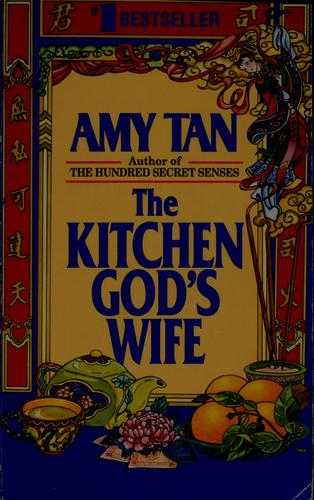
The Kitchen God's Wife
Amy Tan · b. 1952 · United States
Why it matters
A San Francisco daughter finally hears her mother's full story: a first marriage to a monstrous man, survived through wartime China's chaos and shame. Tan's second novel, darker and more historically grounded than The Joy Luck Club.
At a glance
A clear frame narrative around one long, chronological life story.
Deep dive
Why Winnie finally tells her daughter Pearl the real story of her first marriage in wartime China, and what it means that the book ends with Winnie giving an old household god's forgotten wife a name of her own.
Written for readers who have finished the book. No plot recap, and nothing here is safe to read first.
Themes & symbolism
Pearl has kept her own multiple sclerosis diagnosis secret from her mother Winnie for years, a small, private evasion that becomes the novel's frame for the far larger secret Winnie has been keeping her entire adult life: a first marriage to Wen Fu, a Nationalist air force officer whose charm curdles almost immediately into systematic cruelty, rape, infidelity, and control so total that several of Winnie's children by him die of illness and neglect she is given no power to prevent. Tan structures the novel as Winnie's long, unbroken telling to Pearl, mother and daughter finally trading secrets of comparable weight, and makes clear that withheld truth, not distance, is what has kept the two women strangers to each other for decades.
Winnie's escape from Wen Fu, aided by her sharp, pragmatic friend Helen and by Jimmy Louie, the American-Chinese soldier she eventually marries, unfolds against the actual collapse of wartime China, Japanese bombing raids, starvation, the fall of cities, so that her personal survival is never separable from the era's. Tan is careful never to let the historical backdrop excuse or explain Wen Fu individually; his cruelty is domestic and specific even while the country around the marriage is falling apart, which is exactly what makes Winnie's account of surviving both at once so hard-won.
The Kitchen God's Unearned Promotion
The Chinese folk tale behind the title tells of a man who mistreated his wife, lost everything, and was, on dying, elevated by the Jade Emperor to godhood anyway, charged with reporting on every household's behavior despite having failed at his own, while the wife who forgave him goes unnamed and unrewarded. Winnie has spent her life quietly resenting the story's moral, that a cruel man gets sainted while the woman he wronged is forgotten, and Tan uses it as a direct commentary on Wen Fu's postwar respectability and on every reader who has ever excused a powerful man's private failures because of his public position, applause substituting for the accounting he never actually gave.
The last seal: what actually happens, and why it lands the way it does.
The ending, explained
Winnie finally tells Pearl what she has never told anyone, that in the desperate days before her escape, Wen Fu raped her one last time, meaning Pearl's actual paternity, Wen Fu's or Jimmy Louie's, is left genuinely uncertain even to Winnie herself. Rather than resolve the ambiguity, Tan lets it stand as proof of how completely Wen Fu's violence follows Winnie into the life she built specifically to escape him. Winnie answers the old story's silence about the Kitchen God's forgiving, unnamed wife by buying a new altar figurine and naming her Lady Sorrowfree, a small, deliberately unofficial act that gives the story's overlooked woman a name and a place of honor the original myth never thought to offer her.
Where to go next
 Amy Tan · 1989The Joy Luck ClubLvl 4Medium pace
 Edward P. Jones · 2003The Known WorldLvl 6Slow burn
 Pearl S. Buck · 1931The Good EarthLvl 3Medium pace
 E. Annie Proulx · 1993The Shipping NewsLvl 5Medium pace
 Wallace Stegner · 1971Angle of ReposeLvl 6Medium pace
 Richard Russo · 2001Empire FallsLvl 4Medium pace