
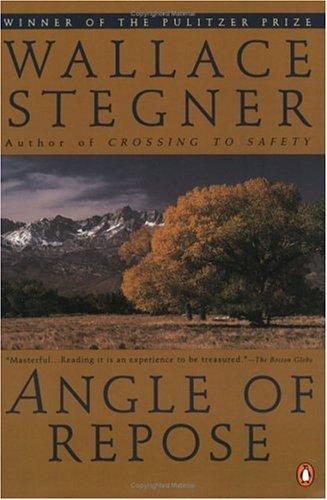
Angle of Repose
Wallace Stegner · 1909–1993 · United States
Why it matters
A wheelchair-bound historian reconstructs his pioneer grandmother's marriage to an engineer across the raw nineteenth-century West, testing her compromises against his own failed one. Stegner's Pulitzer winner is the Western novel's great act of inheritance.
At a glance
Interwoven historical and present-day narration demands tracking two timelines.
Deep dive
What an engineering term for the slope at which loose gravel finally stops sliding is doing as the title of a novel about two ruined and one failing marriage.
Written for readers who have finished the book. No plot recap, and nothing here is safe to read first.
Themes & symbolism
An angle of repose is the steepest slope at which loose material will sit without further sliding — Stegner's title asks how much slippage a marriage, or a family's memory of one, can absorb before it either stabilizes or gives way entirely. Susan Ward's genteel, Ruskin-trained Eastern sensibility is dropped again and again onto Oliver's failing Western engineering projects — canals that don't fill, mines that don't pay — and the gap between her aesthetic ideals and his dirt-and-debt reality becomes the novel's slow-motion version of the Western myth cracking under its own weight.
Lyman Ward is not a neutral historian: wheelchair-bound, abandoned by his wife Ellen for his doctor, he needs Susan to be guilty of something with Frank Sargent and needs Oliver to have forgiven her, because his grandparents' eventual reconciliation is the only precedent he has for imagining his own. He admits to inventing scenes and dialogue the letters don't record, so the 'history' he's assembling is frankly, admittedly partial fiction — Stegner making the case that reconstructing any marriage, including your own, is an act of narrative invention rather than retrieval.
Susan's own career complicates the marriage as much as any affair does: her magazine illustration work, produced to supplement Oliver's chronically failing engineering income, quietly inverts the Gilded Age's assumed division of labor, making her the more reliably employed and more culturally legible of the two long before Frank Sargent ever enters the picture. Oliver's repeated professional collapses, and his wounded, mostly silent pride about being out-earned by his wife's art, are as much a fault line in the marriage as any single scandal — the West humbles his engineering ambitions the same way it never quite validates her civilizing ones.
Stegner and the Woman He Borrowed
Stegner built Susan Ward closely, and controversially, on the real letters and career of Mary Hallock Foote, a nineteenth-century writer-illustrator, without full clearance from her descendants — using another woman's private correspondence as raw material for a novel that is itself about the ethics of one person authoring another's life. The irony is pointed rather than accidental: Lyman does to Susan exactly what Stegner did to Foote, mining an inherited archive of letters to build a version of a woman's inner life she never agreed to publish.
Foote's descendants objected after publication, and the debate has followed the novel's reputation ever since — whether a Pulitzer-winning act of imaginative sympathy can also be a kind of literary appropriation of one specific, identifiable woman's biography. It's a live question the novel itself seems to anticipate without fully answering, since Lyman's project inside the fiction raises exactly the same charge against him.
The last seal: what actually happens, and why it lands the way it does.
The ending, explained
Lyman never fully resolves what happened between Susan and Frank Sargent beyond the tragedy it produced — the drowning deaths of Susan's daughter Agnes and of Frank himself — and the novel doesn't insist on Susan's guilt or innocence so much as on the decades of quiet penance and eventual, wordless reconciliation she and Oliver found in old age. That precedent is what Lyman is really excavating: whether his own marriage to Ellen, broken by his illness and her affair, could survive a similar slow thaw. The book closes with Lyman imagining a future scene of forgiveness so vividly it blurs into dream or wish rather than reported fact, refusing to say whether it's memory, prophecy, or simply what a lonely man needs to believe is still possible.
Where to go next
 Wallace Stegner · 1976The Spectator BirdLvl 4Medium pace
 William Maxwell · 1979So Long, See You TomorrowLvl 5Slow burn
 Wright Morris · 1980Plains Song: For Female VoicesLvl 5Slow burn
 Peter Taylor · 1986A Summons to MemphisLvl 5Slow burn
 Carol Shields · 1993The Stone DiariesLvl 5Medium pace
 Pearl S. Buck · 1931The Good EarthLvl 3Medium pace