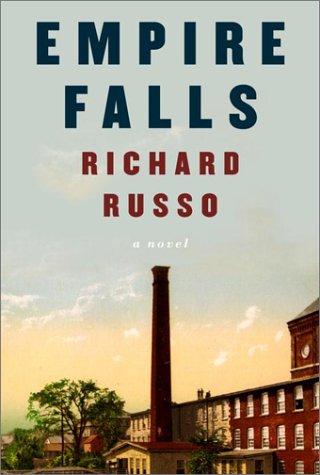
Empire Falls
Richard Russo · b. 1949 · USA
Why it matters
A diner manager in a fading Maine mill town, controlled entirely by one wealthy family, watches failed marriages and old grudges accumulate over a single fateful year. Russo's Pulitzer winner turns small-town economic decline into patient, humane tragicomedy.
At a glance
Large ensemble cast and unhurried pacing, but otherwise clear, accessible realist prose.
Deep dive
How four decades of a Maine mill town's quiet feudalism, run entirely through one family's control of who owns what, finally catches up with Miles Roby — and why Russo makes Francine Whiting's cruelty look, for most of the book, like eccentric small-town color.
Written for readers who have finished the book. No plot recap, and nothing here is safe to read first.
Themes & symbolism
Empire Falls runs on a kind of American feudalism dressed up as ordinary small-town life: the Whiting family has owned the mill, the real estate, and effectively the fates of everyone connected to them for generations, and Miles's own stalled adulthood — running the Empire Grill for a pittance, deferring his own ambitions for decades — reads as debt bondage wearing the costume of loyalty and habit. Francine Whiting, who quietly controls Miles's life via a promise made to his dying mother and a property she dangles rather than gives, is the novel's real antagonist, and Russo's genius is making her cruelty look, for most of the book, like eccentric small-town color rather than what it actually is.
Russo builds the novel on comic patience — failed marriages, deadbeat fathers, teenage crushes, decades-old grudges accumulate in loving, unhurried detail — precisely so the violence that erupts at the end lands as rupture rather than genre payoff. John Voss, the isolated, bullied classmate of Miles's daughter Tick, is sketched throughout with just enough compassion that his eventual act reads as town failure as much as individual pathology: everyone half-noticed him and nobody intervened, the same collective negligence, on a smaller scale, that let the Whitings run Empire Falls into economic ruin unchallenged for a century.
The Whitings' Quiet Feudalism
C.B. Whiting's mill closure, revealed gradually across the novel's flashback chapters, exposes how thoroughly the family's power was always personal rather than merely economic — Francine doesn't just own property, she owns outcomes, doling out just enough hope to Miles, in the promised inheritance of the Empire Grill building, to keep him tethered to a town and a life he might otherwise have left decades earlier. Russo frames this less as villainy in the theatrical sense than as the ordinary machinery of American class stasis, dressed in small-town cordiality.
A Town's Blind Spot
Isolation, casual cruelty, and quiet warning signs around John Voss are seeded through the novel's middle chapters — an offhand worry, an unkindness Tick half-notices and regrets — so that the violence, when it comes, isn't a twist so much as the payoff of tensions the town spent the whole book declining to look at directly. Russo's restraint in building toward it, rather than signaling it outright, is the novel's most serious formal choice, keeping readers inside the same complacency the town itself is being indicted for.
The last seal: what actually happens, and why it lands the way it does.
The ending, explained
John Voss, a troubled, bullied classmate of Tick's, brings a gun into Empire Falls High School, and the violence that follows lands close to Miles's own family and community — a rampage that functions as the novel's thematic culmination as much as its climax, the town's decades of suppressed poverty, neglect, and casual cruelty finally erupting into something no one can any longer treat as ordinary small-town texture. Tick survives. In the aftermath, Miles's long entanglement with the Whiting family loosens; freed at last from Francine's decades of quiet control over his prospects and his inheritance, he gains a measure of independence the rest of the novel had patiently withheld from him, arriving at something like a fresh start built, grimly, out of catastrophe.