
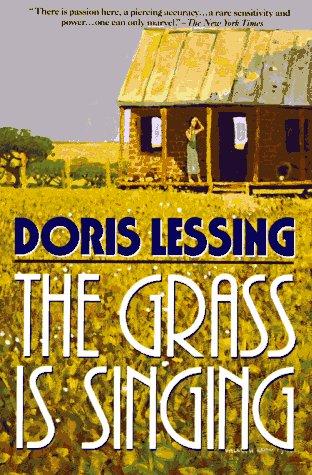
The Grass Is Singing
Doris Lessing · 1919–2013 · United Kingdom / Zimbabwe
Why it matters
A white farmer's wife and her Black servant in colonial Rhodesia move toward a killing the whole society has willed. Lessing's debut dissects the pathology of racism and settler failure with cold clarity.
At a glance
A linear plot told with a doom foretold from the opening page.
Deep dive
A farmer's wife on a failing Rhodesian farm and the Black servant she can neither treat as a person nor stop needing — Lessing's first novel, and already merciless about where that contradiction ends.
Written for readers who have finished the book. No plot recap, and nothing here is safe to read first.
Themes & symbolism
Mary Turner's slow disintegration on the isolated, failing farm she and her ineffectual husband Dick can't make profitable is staged by Lessing as the direct product of settler-colonial Rhodesia's own contradictions: white prestige demands a standard of living and racial distance the Turners' poverty makes a daily humiliation to maintain, and Mary's increasingly erratic, cruel treatment of the farm's Black servants — she can't retain any of them, driving off one after another — is less a personal flaw than the visible fracture line of a whole social system straining against its own economic and psychological limits.
Moses, the servant who eventually stays and comes to occupy an intimacy with Mary that neither of them can name within the colony's rigid racial categories, is written with a psychological interiority Lessing withholds from every other character but Mary, forcing white Rhodesian readers of 1950 to confront a Black character whose dignity, competence, and eventual violence the novel refuses to explain away as simple savagery. The relationship's exact nature — dependency, attraction, degradation, some unstable mixture the two of them can't articulate even to themselves — is left genuinely ambiguous, which is precisely what the surrounding white community, certain such a relationship can only mean depravity or witchcraft, cannot tolerate once it senses something has shifted.
Lessing frames the whole novel backward from its opening newspaper report of Mary's murder, so the narrative operates less as mystery than as forensic social autopsy — every scene builds toward an ending the reader already knows, which lets Lessing focus entirely on how, not whether, the colony's racial and economic order produces this specific catastrophe, indicting the whole settler system's psychology rather than staging a whodunit.
A Colonial Debut That Named the System, Not Just the Marriage
Lessing, who grew up on a Southern Rhodesian farm herself, published the novel in 1950 after leaving the colony for London, and its unflinching treatment of settler poverty, racial anxiety, and the psychological toll of enforcing a color line contributed directly to her being declared a prohibited immigrant in both Rhodesia and South Africa for years afterward. The novel's achievement is that it never lets the Turners' individual failures — Dick's incompetence, Mary's cruelty — stand as a simple morality tale about two bad people; the surrounding white farming community's collective certainty about what 'must' have happened, and its need to suppress the real story once Moses is arrested, indicts the whole colonial order rather than a single marriage gone wrong.
The last seal: what actually happens, and why it lands the way it does.
The ending, explained
In the novel's final pages, Mary — increasingly unstable, aware on some level of what's coming, unable to leave or change the terms of her life with Moses — waits through a stormy night with something close to resigned expectation when Moses finally comes for her with a knife. Lessing declines to render the killing as either simple racial atrocity or crime of passion; it arrives as the only resolution to an impasse the colony's own categories left no language to describe, a relationship that could be lived but never named finally ending in the one act violent enough to force it into the record. Moses makes no attempt to flee and is found waiting calmly near the body, an ending framed not as confession of guilt but as the last agency left to a man the system was built to deny one — horrifying, and within the novel's bleak logic, close to inevitable.
Where to go next
 Doris Lessing · 1952Martha QuestLvl 4Medium pace
 Doris Lessing · 1962The Golden NotebookLvl 8Slow burn
 Doris Lessing · 1974Memoirs of a SurvivorLvl 6Slow burn
 Doris Lessing · 1988The Fifth ChildLvl 4Fast paced
 Simone de Beauvoir · 1954The MandarinsLvl 6Slow burn
 Ingeborg Bachmann · 1971MalinaLvl 8Slow burn