
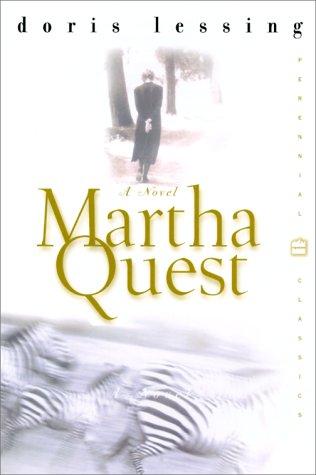
Martha Quest
Doris Lessing · 1919–2013 · United Kingdom / Zimbabwe
Why it matters
A restless teenager chafes against her parents' failing farm, colonial Rhodesia's petty racial codes, and her own contradictory ambitions in the opening volume of the five-book Children of Violence sequence. Lessing's own girlhood recast as the education of a reluctant rebel.
At a glance
A straightforward chronological coming-of-age narrative, accessible despite its political weight.
Deep dive
A teenager's rebellion against her mother, her class, and the racial order of a British African colony sets an escape in motion that doesn't quite look like one by the last page.
Written for readers who have finished the book. No plot recap, and nothing here is safe to read first.
Themes & symbolism
Lessing sets Martha's adolescence in the fictionalized Southern Rhodesia she calls Zambesia, a settler society organized entirely around a color line Martha is trained from birth not to notice, Black farm laborers present in nearly every scene of her childhood and almost never named or spoken to. Her later flirtation with a left-wing reading group in the city, full of refugee intellectuals debating Marx and the coming war, gives her a vocabulary for injustice that she applies everywhere except to the servants in her own parents' house, and Lessing tracks that blind spot without softening it, since the whole quintet this novel opens will spend later volumes making her answer for it.
Martha's war with her mother May Quest runs through clothes, weight, and reading material rather than open argument, May policing her daughter's body and behavior with the same anxious thoroughness she once applied to her own respectability as a settler wife, and Martha rebelling by starving herself thin, reading banned pamphlets, and staying out with men May disapproves of. Lessing frames the fight as generational but also colonial, May's rigid propriety a defense against a country she never wanted to live in, Martha's rebellion a flailing attempt to become someone that country didn't already have a slot for.
The First of Five
Martha Quest opens the Children of Violence quintet, which follows its heroine through four more volumes into the Second World War, a failed first marriage, Communist Party politics, and eventual emigration to London, a scope Lessing plotted out drawing heavily on her own Rhodesian girlhood and her years as a Communist Party member before she left both the colony and the Party behind. Read as the opening movement of that longer arc rather than a self-contained novel, Martha's choices here read less as resolutions than as the first in a long series of doors she'll spend the rest of the sequence discovering she walked through for the wrong reasons.
The Sports Club Teaches What the Reading Group Can't Undo
Long before Martha finds Solly and Joss Cohen's left-wing study circle, she has already spent years being drilled by the town's Sports Club dances and sundowner parties, the real finishing school for Zambesia's white settler youth, where flirtation, dress, and who a girl is seen leaving with matter more than any idea being debated in the room. Lessing keeps sending Martha back to these dances even after her political education begins, and the return is deliberate: a few evenings spent arguing Marx with refugee intellectuals cannot out-compete years of socialization that has already taught Martha's body, whatever her mind now claims to believe, exactly what a young white woman in this colony is supposed to become.
The last seal: what actually happens, and why it lands the way it does.
The ending, explained
Martha accepts a whirlwind proposal from Douglas Knowell, a civil servant she barely knows, and the wedding follows within weeks, in a decision that reads on the surface like defiance, a hasty ceremony her mother didn't arrange and can't fully approve of, but functions structurally as exactly the kind of colonial respectability Martha has spent the whole book fleeing. Lessing gives no indication the union will last, and readers of the later quintet know it doesn't; the wedding that closes the volume is less a happy ending than a trap Martha has built for herself out of the only materials Zambesia gave her to rebel with.
Where to go next
 Doris Lessing · 1950The Grass Is SingingLvl 4Medium pace
 Doris Lessing · 1962The Golden NotebookLvl 8Slow burn
 Doris Lessing · 1974Memoirs of a SurvivorLvl 6Slow burn
 Doris Lessing · 1988The Fifth ChildLvl 4Fast paced
 Simone de Beauvoir · 1954The MandarinsLvl 6Slow burn
 Ingeborg Bachmann · 1971MalinaLvl 8Slow burn