
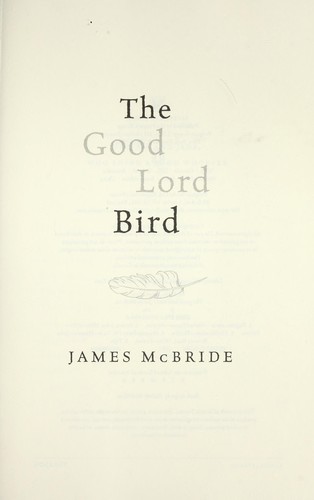
The Good Lord Bird
James McBride · b. 1957 · United States
Why it matters
An enslaved boy mistaken for a girl is swept into John Brown's doomed abolitionist crusade, narrating Harpers Ferry's chaos in a voice as comic as it is damning. McBride's National Book Award winner turns American historical myth inside out.
At a glance
Comic vernacular narration moves briskly despite handling slavery's horror directly.
Deep dive
How a mistaken-for-a-girl slave boy narrating John Brown's crusade lets McBride mock American myth-making without ever quite dismissing the myth.
Written for readers who have finished the book. No plot recap, and nothing here is safe to read first.
Themes & symbolism
Henry Shackleford's accidental disguise — mistaken for a girl by Brown in the chaos of a saloon shootout and simply never corrected, for years — is less a plot device than the novel's method for talking about identity generally: Onion becomes whoever the person looking at him needs him to be, a slave, a girl, a mascot, a soldier, and McBride uses that pliability to satirize how thoroughly identity in antebellum America was assigned by white observers rather than chosen. The title's ivory-billed woodpecker, the Good Lord Bird, is a near-extinct symbol of freedom and luck that Brown reveres almost superstitiously; its rarity is the point, a species clinging to existence the way Brown's crusade does, gorgeous and doomed at once.
McBride's real subject is the unreliability of righteous conviction: Brown is drawn as a genuine holy fool, ranting, disorganized, occasionally comic, and yet — unlike nearly every other white character in the book — the one man who consistently, sincerely means to end slavery rather than merely profit from arguing about it. The tall-tale, picaresque voice, descended straight from Twain, lets McBride get away with staging slavery's horror and Brown's absurdity in the same breath, using comedy as a Trojan horse for material a straightforwardly solemn novel might flinch from.
Deflating the Abolitionist Pantheon
Frederick Douglass appears as vain, drunk, and grabby, more interested in his own celebrity than in Brown's plan, while Harriet Tubman is rendered with real, understated reverence — McBride using the contrast to separate performed righteousness from the harder, quieter kind. It's a deliberate provocation against textbook hagiography, insisting that the era's icons were as fallible and self-interested as anyone, while reserving genuine awe for the people history remembers less loudly.
A Boy Who Passes, and What That Costs
Onion's years living as a girl aren't played purely for laughs — he's repeatedly protected, propositioned, and burdened with expectations specific to how each new white or Black adult reads his body, and McBride lets that shifting treatment expose how little say enslaved people had over their own legible identity in the first place. The disguise, sustained partly out of fear and partly out of simple inertia, becomes Onion's whole survival strategy, a passivity the novel treats with more sympathy than judgment, since agency was the one thing slavery was designed to make structurally impossible.
The last seal: what actually happens, and why it lands the way it does.
The ending, explained
Brown's real October 1859 raid on the federal armory at Harpers Ferry collapses within hours, as the small, poorly supplied band is surrounded by militia and federal troops; Brown is captured, tried swiftly, and hanged for treason. Onion survives the raid's chaos and its aftermath, having spent the whole novel doubting Brown's sanity and strategy while never quite escaping his orbit or his strange magnetism. Looking back as narrator, Onion's tone stays comic even at Brown's death, but the irreverence never fully undercuts a real, complicated respect — McBride's final joke is that a man that ridiculous, and that disastrously prepared, might still have been right.
Where to go next
 Charles Johnson · 1990Middle PassageLvl 5Fast paced
 John Kennedy Toole · 1980A Confederacy of DuncesLvl 4Fast paced
 DBC Pierre · 2003Vernon God LittleLvl 5Fast paced
 Daniel Kehlmann · 2005Measuring the WorldLvl 4Fast paced
 Andrea Barrett · 1996Ship Fever and Other StoriesLvl 5Medium pace
 A. M. Homes · 2012May We Be ForgivenLvl 5Fast paced