
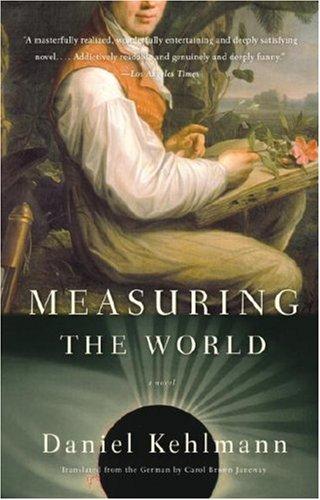
Measuring the World
Daniel Kehlmann · b. 1975 · Germany / Austria
Originally Die Vermessung der Welt (German) · translated by Carol Brown Janeway
Why it matters
Reclusive mathematician Carl Friedrich Gauss and restless explorer Alexander von Humboldt pursue the same Enlightenment ambition (measuring the world exactly) from opposite ends of a life. Kehlmann's international bestseller turns genius and eccentricity into deadpan historical comedy.
At a glance
Brisk, accessible prose despite alternating between two historical timelines.
Deep dive
One genius travels to the ends of the earth counting everything he sees; the other never leaves his desk and considers that cheating. Kehlmann sets the Enlightenment's two methods of knowing the world loose on each other.
Written for readers who have finished the book. No plot recap, and nothing here is safe to read first.
Themes & symbolism
Humboldt and Gauss are structured as photographic negatives of the same ambition: total, rational possession of the universe. Humboldt gets there by motion — climbing volcanoes, wading through piranha-infested rivers, subjecting his own body and his companions' to degrading, occasionally dangerous measurement, as though nothing has really happened to him until it's been converted into a number. Gauss gets there by sitting still, regarding travel as an indignity beneath pure mathematics and resenting every hour it costs him at his desk. Kehlmann's deadpan comedy comes from refusing to crown either method: Humboldt's empiricism produces real discovery and real farce in roughly equal measure, and Gauss's abstraction produces real genius alongside a marriage and a father-son relationship he's too impatient to actually attend to.
The running joke that cuts deepest is what total measurement costs the people standing next to the measurers — wives neglected, servants worked half to death, indigenous guides treated as instruments rather than informants, all in the name of Enlightenment knowledge that never quite gets around to noticing them as people. Kehlmann is gently mocking a very German, very period-specific faith that the world can be fully captured by rigor, whether the rigor of the sextant or the rigor of the proof, and showing that faith producing brilliance and cruelty from the same motion.
Two Kinds of German Genius
Kehlmann alternates the two men's chapters rather than braiding their stories together for most of the book, a structural choice that keeps them as parallel lines rather than a single plot — appropriate, since neither man particularly wants the other's company. Gauss's sections are acidic and impatient, full of irritation at lesser minds; Humboldt's are manic and slightly absurd, full of the sheer physical comedy of a man who cannot simply look at a cave without wanting to descend into it with instruments strapped to his back. The comic tone throughout is drier than either man's self-regard, which is the book's real joke. Kehlmann's prose, deliberately flat and free indirect, refuses to editorialize on either man's absurdity, trusting the reader to notice the gap between how seriously these geniuses take themselves and how minor most of their actual triumphs look once translated into ordinary human terms.
The last seal: what actually happens, and why it lands the way it does.
The ending, explained
The two men finally meet in the flesh late in life, at a scientific congress in Berlin, and the encounter is written as a deliberate anticlimax: two towering, difficult old men who don't especially like or understand each other, each privately convinced his own method — the sextant or the equation — was the truer path to knowing the world, neither willing to concede the point. There's no synthesis, no mutual epiphany. Kehlmann closes the novel on that muted, comic diminishment, affectionate toward the scale of both men's ambition and gently deflating about its pretension to have ever added up to total mastery of anything.
Where to go next
 Vladimir Nabokov · 1955LolitaLvl 8Medium pace
 Bernhard Schlink · 1995The ReaderLvl 3Medium pace
 Martin Amis · 1984MoneyLvl 6Fast paced
 Christa Wolf · 1968The Quest for Christa T.Lvl 7Slow burn
 Heinrich von Kleist · 1810Michael KohlhaasLvl 6Fast paced
 Colum McCann · 2009Let the Great World SpinLvl 5Medium pace