
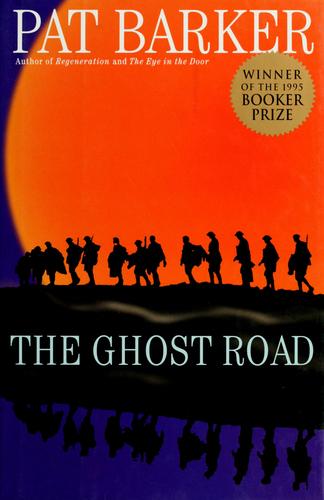
The Ghost Road
Pat Barker · b. 1943 · England
Why it matters
Wounded soldier Billy Prior returns to the front as anthropologist W. H. Rivers recalls a headhunting culture that ritualized the death Prior is about to face. The Booker-winning close to Barker's Regeneration trilogy.
At a glance
Two intercut timelines and a large ensemble, otherwise clear realist prose.
Deep dive
Two timelines running in parallel — a recovering officer sent back to a war in its final, bitter weeks, and an anthropologist's memories of a warrior culture stripped of its reason to exist — and the uncomfortable equivalence Barker draws between them.
Written for readers who have finished the book. No plot recap, and nothing here is safe to read first.
Themes & symbolism
Rivers's 1908 fieldwork on Eddystone Island supplies the novel's real argument: the Melanesian islanders he studied had organized their entire culture around headhunting, and when British colonial administrators banned the practice, they didn't liberate the islanders so much as gut them — deprived of the ritual structure that gave their lives meaning, the population begins simply dying out, a kind of collective despair with no other name for it. Barker's parallel to the war is exact rather than merely suggestive: Rivers's own profession, psychiatric medicine deployed to patch soldiers up and certify them fit to return to the front, is no less a culture organized around ritualized killing than the one he studied as a detached scientific observer. The 'primitive' society he pities and the 'civilized' one that employs him turn out to be the same machine wearing different justifications.
Billy Prior, recovered enough to be passed fit, carries the novel's other central image: a notebook he keeps compulsively, framed from early on as an object that will outlive him, found among a dead man's effects rather than read by its author. Writing becomes, for Prior, both a way of asserting a self the war keeps trying to erase and a rehearsal for his own posthumousness — the diary form itself is a small death sentence he's narrating in advance, its final entries getting shorter and more clipped as the front approaches.
The Eddystone Fieldwork
Barker draws directly on the real W. H. R. Rivers's own ethnographic career — he had genuinely done fieldwork among Melanesian headhunting cultures decades before treating shell-shocked officers — and uses the historical record almost as found material. The novel's Rivers relives these memories involuntarily, in fragments, precisely because they won't stay safely categorized as anthropology; the more time he spends returning damaged men to a war organized around slaughter, the less he can pretend his professional distance from the islanders' 'savagery' means anything.
The last seal: what actually happens, and why it lands the way it does.
The ending, explained
Prior is killed in action during the war's final days, in the last hours before the Armistice — the news arriving through his own notebook, recovered among his effects, its last entry breaking off mid-sentence exactly as the trilogy has been warning it would. The timing is the point: a death rendered obscene by its proximity to peace, the war claiming him in the margin of time when it had, in every practical sense, already ended. Rivers receives the news at home, and the grief is inseparable from professional collapse — every soldier he certified fit to return, including Prior, he sent back into a machine he had spent the whole book coming to see as no more rational than the headhunting he'd once studied from a comfortable distance.
Where to go next
 Pat Barker · 1991RegenerationLvl 4Medium pace
 Penelope Lively · 1987Moon TigerLvl 6Medium pace
 Ian McEwan · 2001AtonementLvl 5Medium pace
 Kazuo Ishiguro · 1989The Remains of the DayLvl 5Slow burn
 J. G. Farrell · 1973The Siege of KrishnapurLvl 5Medium pace
 Bapsi Sidhwa · 1991Cracking IndiaLvl 3Medium pace