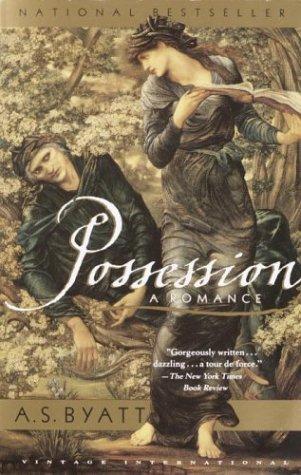
Possession
A. S. Byatt · 1936–2023 · England
Why it matters
Two contemporary academics uncover a hidden love affair between two invented Victorian poets, told through forged letters and pastiche verse. A Booker-winning fusion of detective plot and literary scholarship.
At a glance
Interweaves pastiche Victorian poetry, letters, and scholarly apparatus with the main plot.
Deep dive
The scene the whole novel builds toward that its own characters never get to read — and what that says about what scholarship can and can't recover.
Written for readers who have finished the book. No plot recap, and nothing here is safe to read first.
Themes & symbolism
The title's pun is the argument: possession as owning an archive (Mortimer Cropper, the acquisitive American collector, wants Ash's papers as trophies to be catalogued and controlled) versus possession as being possessed by another person, erotically or emotionally, which is what actually happened between Ash and LaMotte and what Roland and Maud, guardedly, start to feel for each other over the course of their research. Byatt stages literary scholarship itself as a kind of appetite that can shade into violation — Cropper literally digs up a grave to get at buried letters — and sets against it a more patient, humbled way of reading that the novel ultimately rewards.
Christabel LaMotte's daughter, given away at birth and raised believing herself the child's aunt, models a whole hidden lineage of women's literary and personal history, suppressed by Victorian propriety and nearly lost again to modern scholarship's assumptions about what mattered enough to preserve. Roland and Maud's tentative, thoroughly modern romance mirrors Ash and LaMotte's without repeating it — muted by academic self-consciousness and a wary unwillingness to perform the grand passion they're busy studying, which is Byatt's own dry joke about how much smaller contemporary love can feel next to its own literary inheritance.
The Coda: What Only the Reader Knows
Byatt's closing device is the novel's real formal argument: an unnumbered final scene, addressed directly to the reader and explicitly outside the discoverable record, shows Ash meeting his and Christabel's daughter once, alone, in a meadow, without either of them ever telling anyone. Roland and Maud, who have spent the entire novel painstakingly reconstructing this affair from letters and inference, never learn this happened — the reader alone possesses it. It's a pointed rebuke to the idea that scholarship, however rigorous, ever fully recovers the past; the best it can do is get admirably, movingly close.
Pastiche as a Working Argument
The invented Victorian poems, letters, and journals that Byatt writes for Ash and LaMotte aren't decorative ventriloquism — they're functional literature the reader has to fall for exactly as Roland and Maud do, feeling their pull before any biographical context arrives to explain them. By making the pastiche genuinely good, Byatt tests her own thesis: does knowing the life behind a poem deepen a reading of it, or does the hunger to explain art through biography just distract from what's actually on the page?
The last seal: what actually happens, and why it lands the way it does.
The ending, explained
In the contemporary plot, Roland and Maud become a couple, and a portion of the Ash-LaMotte mystery resolves for them — enough to publish, enough to feel the affair vindicated against a century of misreading, and enough for Roland, whose academic career has otherwise stalled, to finally claim some authority of his own. But it's an incomplete resolution: they never learn about Ash's secret meeting with his daughter, the one scene that would have told them the fullest truth of what the affair produced. Byatt gives the reader that missing scene directly, in a private coda the scholars never access, making dramatic irony the novel's final method — literary history, however devotedly pursued, is shown to be recoverable only in part, with the deepest truths belonging to the dead and, briefly, to us.