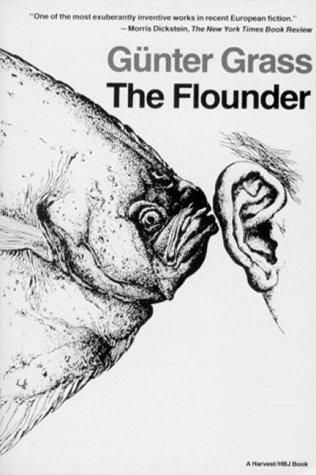
The Flounder
Günter Grass · 1927–2015 · Germany
Originally Der Butt (German)
Why it matters
A talking, millennia-old flatfish that once counseled the patriarchy stands trial before a tribunal of feminists, narrating nine successive ages of cooking, eating, and the war between the sexes. Grass at his most gleefully excessive and encyclopedic.
At a glance
A sprawling, digressive structure spanning millennia with no single throughline plot.
Deep dive
Why a talking fish that once advised the men who built civilization is finally on trial before a feminist tribunal, and what nine cooks across three thousand years have to do with the verdict.
Written for readers who have finished the book. No plot recap, and nothing here is safe to read first.
Themes & symbolism
Grass builds the novel around nine cooks, one for each of the nine months of his contemporary wife Ilsebill's pregnancy, stretching from the Neolithic matriarch Aua through medieval, Reformation, and Napoleonic-era Danzig down to the twentieth century, each woman feeding and shaping the men around her while a talking flounder, first caught by Aua and passed down through the ages as an advisor, steers those same men toward technology, hierarchy, and war. The structure argues that history's real engine was never battles or kings but who fed whom, and what the flounder actually taught its long line of male confidants was how to take credit for it.
Food itself displaces politics as the book's true substrate: herring counts, cabbage recipes, and, above all, the introduction of the potato to Kashubia by the eighteenth-century cook Amanda Woyke carry more historical weight here than any treaty. Grass folds real Danzig figures into the invented lineage, the medieval brewer and killer Mestwina, the ascetic mystic Dorothea of Montau, giving the fable a regional density that ties The Flounder to the same Danzig obsession running through The Tin Drum, just excavated three thousand years deeper.
Fat Gret's Kitchen as a Weapon
Margarete Rusch, a sixteenth-century Danzig abbess Grass draws from an actual historical figure, uses her kitchen against the Swedish and imperial soldiers occupying the city, feeding them into gluttonous stupors and, in the novel's telling, sometimes to death, turning hospitality itself into an instrument of resistance. Grass gives her more appetite, more cunning, and more outright killing than any other cook in the book's nine-part lineage, making her the clearest case of food as direct, physical power rather than metaphor.
The Grimm Tale the Whole Book Rewrites
Grass borrows both the flounder and the name Ilsebill from the Brothers Grimm's "The Fisherman and His Wife," in which a magic fish grants a greedy wife's escalating wishes until she overreaches and loses everything. He inverts the folk tale's moral: instead of a woman punished for wanting too much, it is men across three thousand years who keep asking the fish for more, technology, empire, dominance, and the contemporary tribunal finally forces the flounder to answer for having granted it every time.
The last seal: what actually happens, and why it lands the way it does.
The ending, explained
The tribunal's cross-examination of the flounder, at once absurd and genuinely damning, never produces a clean verdict: pressed on three thousand years of advice given exclusively to men, the fish escapes rearrest and slips back into the sea rather than delivering the single confession the book's nine cooks were each, in their own century, reduced to serving. In the present-day frame, Ilsebill gives birth, and the narrator, having spent nine months excavating a history of women who fed the men who wrote it, ends on the ordinary resumption of domestic life rather than any resolution. Grass declines to award total victory to anyone: the matriarchal past wasn't paradise, the feminist present isn't utopia, and the flounder outlasts every century's attempt to make it answer for both.