
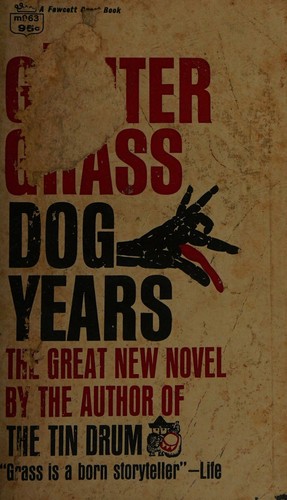
Dog Years
Günter Grass · 1927–2015 · Germany
Originally Hundejahre (German)
Why it matters
Two boyhood friends, one gentile and one part-Jewish, drift into complicity and betrayal against Danzig's Nazi rise, tracked partly through the pedigree of a real dog that ends up in Hitler's kennel. The sprawling third panel closing Grass's Danzig Trilogy.
At a glance
Three interlocking narrators and dense wordplay make this the trilogy's most demanding volume.
Deep dive
How a dog's pedigree, traced from a Danzig farm to Hitler's own kennel, ends up carrying more of Grass's history than either of its two human narrators.
Written for readers who have finished the book. No plot recap, and nothing here is safe to read first.
Themes & symbolism
Eddi Amsel, half-Jewish and the more inventive of two Danzig boyhood friends, builds scarecrows on an industrial scale from his family's farm, elaborate, uncannily lifelike figures that unsettle everyone who sees them and that Grass treats as genuine art decades before anyone in the novel would use that word for them. Walter Matern, his gentile friend, admires and resents the scarecrows in roughly equal measure, and the novel tracks their friendship through exactly the years, the 1920s into the Nazi rise, when that mixture curdles into something violent.
The dog lineage that gives the novel its title, traced obsessively across three generations of Danzig-area breeding records, culminates in Prinz, a descendant given as a gift to Hitler and photographed at his side, and Grass uses the pedigree charts, reproduced in the text with the same bureaucratic precision the Nazis brought to their own records of ancestry, to make a mordant point about what the regime actually valued tracking: bloodlines, whether canine or human, kept with obsessive documentary care.
Matern Beats Amsel's Teeth Out With Ice Skates
In one of the trilogy's most brutal single scenes, Matern, now in the SA, joins a mob that ambushes Amsel and beats him half to death, knocking out every one of his teeth with a set of ice skates used as knuckledusters, a betrayal by his oldest friend that Grass stages without any of the black comedy that softens most of the novel's violence. Amsel survives, disappears from Danzig entirely, and resurfaces after the war as the wealthy businessman Brauxel, or Goldmouth, his ruined mouth rebuilt entirely in gold, a transformation that turns the assault's literal damage into the visible proof of who he had to become to survive it.
Matern's Traveling Revenge, Dachshund by Dachshund
Postwar, Matern tours occupied Germany ostensibly to settle scores with former Nazis, but the revenge he actually delivers is petty and displaced, seducing and infecting women with gonorrhea, poisoning dachshunds belonging to men he holds grudges against, gestures so disproportionate to the crimes they're meant to answer that Grass turns the whole tour into a bitter joke about postwar Germany's appetite for cheap, symbolic reckoning instead of the real kind. Matern never once confronts what he did to Amsel directly, the one debt his entire revenge tour is actually circling.
The last seal: what actually happens, and why it lands the way it does.
The ending, explained
Brauxel, revealed across the novel's final section to be Amsel writing under a new identity and running a scarecrow factory turned into an underground mine and museum, orchestrates a reunion with Matern that is less reconciliation than exhibition: Matern is made to walk through galleries of scarecrows built to resemble the very Nazi and postwar figures his revenge tour was supposed to punish, confronted with artful replicas rather than the living people he could never actually make answer for anything. Grass declines to grant either man forgiveness or a clean settling of accounts; the pedigree that opened the novel, ending in Hitler's dog, closes instead in Amsel's museum of grotesques, history preserved as craft because it was never available as justice.
Where to go next
 Günter Grass · 1959The Tin DrumLvl 8Medium pace
 Günter Grass · 1961Cat and MouseLvl 6Medium pace
 Günter Grass · 1969Local AnaestheticLvl 6Slow burn
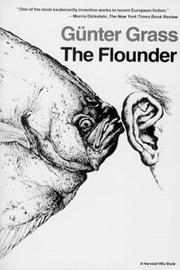 Günter Grass · 1977The FlounderLvl 8Slow burn
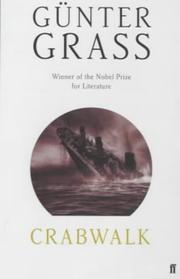 Günter Grass · 2002CrabwalkLvl 6Medium pace
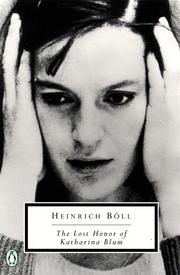 Heinrich Böll · 1974The Lost Honour of Katharina BlumLvl 4Fast paced